Welcome

Welcome to Grappy's Soap Box - a platform for insightful commentary on politics, media, free speech, climate change, and more, focusing on Australia, the USA, and global perspectives.
Showing posts with label Climate Change. Show all posts

Sunday, 30 August 2026

Climate, Energy and Prosperity: The Debate That Shapes Our Future


Few issues reach as deeply into modern life as climate change and energy.

Climate change begins as a scientific question: How much is the Earth warming? How much is caused by human activity? What might happen in the decades ahead?

But deciding what we should do about it takes us much further.

It involves engineering, economics, politics, international relations and ethics. It affects electricity prices, transport, industry, agriculture, government spending and ultimately our cost of living.

At the centre of it all is energy.

Energy and the Modern World

Modern civilisation depends upon abundant, reliable and affordable energy. It powers our homes, hospitals, factories, transport and communications. Fossil fuels also provide raw materials for fertilisers, plastics, pharmaceuticals and countless everyday products.

Yet burning fossil fuels produces greenhouse gases, and governments around the world have committed enormous resources to reducing emissions.

That creates one of the great policy dilemmas of our age:

How do we reduce our environmental impact without undermining the prosperity and technological capacity that make modern civilisation possible?

There are no simple answers.

Beyond "Is Climate Change Real?"

The Earth has warmed since the nineteenth century, and human greenhouse-gas emissions contribute to that warming.

But that does not settle the debate.

How much future warming should we expect? How reliable are climate models? How much damage will warming cause? How much can we adapt? And, most importantly, which policies provide the greatest benefit for their cost?

Those questions deserve open examination.

So do the proposed solutions.

Wind and solar offer low-emission electricity but are weather-dependent. Nuclear provides reliable low-carbon power but brings questions of cost, construction time and waste. Batteries and transmission networks have important roles but substantial costs. Electric vehicles eliminate tailpipe emissions but require considerably more mineral extraction.

Every technology involves trade-offs.

The Economic Question

Energy prices flow through almost everything we buy.

More expensive electricity increases the cost of manufacturing, mining, construction, transport, food and services. Industries that depend upon cheap energy can become uncompetitive or move overseas.

Climate policy therefore cannot be assessed simply by counting tonnes of CO₂ avoided.

We also need to ask:

What does it cost? What does it achieve? And are there better ways of achieving the same objective?

That is particularly important with Net Zero, which potentially involves transforming electricity generation, transport, industry, agriculture and buildings over just a few decades.

The Moral Questions

Climate policy also raises questions that cannot be answered by climate models.

Today's wealthy countries achieved their prosperity using abundant coal, oil and gas. Billions of people in developing nations are still seeking the reliable electricity, clean water, refrigeration, transport, hospitals and industry that we take for granted.

Do wealthy countries have the right to deny poorer countries access to inexpensive energy?

And who should bear the greatest burden of reducing emissions: today's largest emitters, the countries responsible for the greatest historical emissions, or everyone equally?

There is another moral question closer to home.

Governments routinely restrict individual freedom for the common good. But how far should that extend in pursuing climate objectives?

Should governments determine which cars we drive, which appliances we use or which technologies generate our electricity? How much additional cost can reasonably be imposed on today's population to obtain benefits expected decades into the future?

There are legitimate arguments on both sides.

A Continuing Conversation

I have been writing about climate change and energy since Grappy's Soapbox began.

My views have evolved as the evidence, technology and politics have changed—and I expect they will continue to do so.

This page therefore isn't intended to provide the final word.

It is a gateway to the discussion.

Below is a selection of previous posts examining the science, economics, technology and ethics of climate and energy policy. New articles will be added as the debate develops.


Explore Climate & Energy

Climate Science & Evidence

Six Charts Put Climate Alarmism into Perspective
A recent look at claims surrounding extreme weather, fires, floods, disease and mortality in their historical context.

The Real Climate Deniers, Those Who Want to Erase the Past
Why historical climate records matter when assessing claims about today's climate.

The Sunlight Shuffle: John Clauser's Revelation Shakes Up Climate Models
Nobel laureate John Clauser's challenge to aspects of climate modelling, particularly the role of clouds and reflected sunlight.

Credo on Climate Change
An early attempt to set out my position in what was already becoming a highly polarised debate.

Is the World Warming … to Climate Change?
One of my earliest examinations of climate change and the evidence surrounding it.


Net Zero, Energy & Economics

The Australian Net Zero Cost Clock
An ongoing attempt to make at least some of the costs of Australia's Net Zero policies visible.

Is Net Zero Desirable?
A discussion of whether eliminating fossil fuels is practical—or even desirable—given their role in modern civilisation.

Abundant Energy Drives the Modern World
The relationship between affordable energy, economic development and human prosperity.

Australia's Renewables Obsession
Examining the implications of Australia's rapid transition towards wind and solar generation.

Net Zero Destroys the Economy
Considering the wider economic consequences of expensive energy and Net Zero policies.


Renewables, Nuclear & Technology

Is Spain the Canary in the Renewables Coalmine?
What Spain's major blackout might tell us about electricity systems containing large amounts of intermittent generation.

Intermittent Renewables Cause Grid Instability
The engineering challenge of maintaining a stable electricity grid as wind and solar generation increase.

What the Heck Is Thorium?
An early look at thorium reactors and their potential role in low-carbon energy generation.

EVs: Green Dream or Environmental Mirage?
Looking beyond tailpipe emissions to battery production, critical minerals, mining and the broader environmental footprint of electric vehicles.


Climate Justice & Who Should Pay?

In 2015 I wrote a five-part series attempting to answer a deceptively simple question:

What would constitute a fair global greenhouse-gas reduction target?

Seeking a Fair GHG Reduction Target — Part 1: The Problem

Part 2: Current Climate Change Measures Are Misleading

Part 3: Misleading Measures — Misleading World Ranking

Part 4: Propositions for Consensus

Part 5: Who Is Responsible?

And two related articles:

Climate Change Theatrics, Again!
Why historical emissions as well as current emissions matter when considering national responsibility.

Is Australia One of the Worst Net Emitters in the OECD?
An examination of how national emissions performance is measured and compared.


Where Next?

The climate and energy debate will not stand still.

Technology will change. Climate observations will accumulate. Electricity systems will evolve. Governments will change policy. Some predictions will prove correct and others will not.

This article will evolve with them.

New Climate & Energy posts will be added here, and older posts revisited where new evidence warrants it.

The objective is not to defend a fixed position. It is to keep asking the questions that matter:

What is happening? How serious is it? What can realistically be done? What will it cost? Who should pay? And what unintended consequences might follow?

Last updated: August 2026

Tuesday, 9 December 2025

The Real Climate Deniers, Those Who Want To Erase the Past

Climate orthodoxy has a fatal weakness — history.

A recent video, “Big Trouble in the Little Ice Age,” lays out a simple but devastating truth: the Earth has warmed and cooled dramatically long before fossil fuels. And today’s climate establishment can’t allow that truth to be acknowledged, because it breaks the “CO₂ controls everything” narrative that underpins Net Zero politics.

Here are the key points the activists want erased.

1. The Little Ice Age Was Real — and Global

From roughly 1300 to 1850, the world endured centuries of cold, storms, crop failures and social disruption. Evidence appears in:

  • Europe

  • North America

  • China

  • The Southern Hemisphere

  • Antarctica

Not a “regional anomaly”—a global cold era.

2. Before That, the Medieval Warm Period Was Also Real

Between 900 and 1300 AD:

  • Vineyards thrived in England

  • Norse settlers farmed in Greenland

  • Harvests boomed

  • Many regions were warmer than today

This was long before fossil fuels.

That is why climate activists try so hard to write it out of history: natural warming undermines the dogma.

3. The Sun, Not CO₂, Explains the Shifts

The Little Ice Age coincided with major solar minimums, especially the Maunder Minimum.
Sun dimmed → world cooled.
Solar cycles matter. Models ignoring them are broken by design.

4. Cold Brings Chaos — Warmth Brings Stability

History contradicts modern climate rhetoric:

  • The Medieval Warm Period was prosperous and calm

  • The Little Ice Age brought famine, storms, failed harvests, and population decline

Yet today we’re told warming is the danger.
The past says otherwise.

5. Glaciers Began Retreating Before Industrialisation

European and Alaskan glaciers started shrinking around 1800–1850, well before significant CO₂ emissions.
If modern retreat began before fossil fuels, CO₂ cannot be the sole driver.

6. Erasing the Past Is the Real “Climate Denial”

Those who deny:

  • the Medieval Warm Period

  • the Little Ice Age

  • historical weather extremes

  • solar influence

  • natural climate variability

…aren’t protecting science — they’re protecting a political narrative.

The Bottom Line

Climate changes. It always has.
But the idea that every shift today must be human-caused — and catastrophic — is contradicted by centuries of recorded history.

When governments rewrite the past to justify Net Zero’s costs and controls, they cross the line from science into ideology.

Understanding the Little Ice Age doesn’t “deny climate change.”
It simply denies the simplistic story used to reshape economies and erode freedoms.

And that’s exactly why they don’t want you to look too closely.

Here is the video. Well worth the 15minutes.


Wednesday, 3 September 2025

Inconvenient Truths: 5 Climate Experts Push Back Against Alarmist Zealotry

Fear sells. From every fire to freak weather, mainstream media and green activists tell us a climate catastrophe is upon us. But what happens when a group of seasoned climate scientists issues a reality check? That’s precisely what happened—and shockingly, most major outlets barely covered it.

A recent Sky News segment, “‘Grossly exaggerated’: Media gives ‘little attention’ to new bombshell climate report,” spotlighted a U.S. Department of Energy report authored by five esteemed scientists challenging alarmist narratives. Now let’s meet them and see what they actually claimed.

Meet the Voices of Reason

From Iowa Climate Science Education’s coverage, here’s who put their reputations on the line:

  1. Professor Emerita Judith Curry – A prolific climate researcher with nearly 200 peer-reviewed papers. Once part of the IPCC, she now argues that risks are often exaggerated. (Iowa Climate Science Education)

  2. Dr. Roy Spencer – A NASA Senior Scientist known for leading what’s considered one of the most accurate global temperature measurement systems. (Iowa Climate Science Education)

  3. Professor Ross McKitrick – An expert reviewer for multiple UN IPCC reports, offering rigorous analysis of claim versus reality. (Iowa Climate Science Education)

  4. Professor John Christie – A former lead author of an IPCC report who contends, “climate models and popular surface temperature datasets overstate real atmospheric changes.” (Wikipedia)

  5. Dr. Steven E. Koonin – Physicist, ex-Under Secretary for Science at the Department of Energy under Obama, and vocal critic of media simplification and model limitations. (Wikipedia)

Key Findings: What Challenges the Alarmism?

According to the report and accompanying interviews:

  • Climate models are unreliable—“all over the shop”—and often overpredict warming by around 1°C or more, meaning severe impacts may be overstated. (Iowa Climate Science Education)

  • Extreme weather trends lack compelling links to climate change—the data do not support the mainstream assertion that climate change causes every storm, drought, or fire. (Iowa Climate Science Education)

  • Even using the flawed models, the economic damage of warming is minimal, and aggressive mitigation risks doing more harm than good. (Iowa Climate Science Education)

Media Missing in Action

You’d think a report by five high-profile scientists pushing back on climate hysteria would dominate headlines. Instead? Relative silence.

Media commentators like Andrew Bolt highlighted the omission—calling it “proof that the warming scare is grossly exaggerated”. (ysb.co.NZ, Iowa Climate Science Education)

But mainstream outlets? Either dismissed the report as fringe—like The Guardian and others—or buried it without meaningful discussion. The media continues to favour alarm over analysis. (ysb.co.nz)

Why This Matters—Especially for Australia

  • Australia’s emissions are just 1.1% of global CO₂. Even eliminating them entirely changes nothing.

  • Yet our energy costs are soaring, industries are shutting, and households—especially the poorest—are hurt by renewable subsidies and regulatory overreach.

  • Another state of emergency will only drive more of the economy and commons into the ground, while the actual impact on the global climate remains nil.

Wrap-Up

This isn’t denialism. These are heavyweight scientists demanding honest conversation. Models have limits. Headlines should reflect nuance. And policy should be driven by evidence—not fear.

Let’s stop the narrative-driven panic and insist on reasoned, balanced, and effective climate solutions.


Here is a recent interview of Dr Koonin by Andrew Bolt covering some of these arguments.


Monday, 11 August 2025

Reality Check: Green Energy Isn’t the Silver Bullet

So I caught a clip of Bjørn Lomborg on The Rubin Report—titled “Scientist Destroys Green Energy Narrative w/ Facts in Minutes”—and it hits like a cold bucket of water. Here’s the honest tea: solar and wind might sound cheap, but in reality? They're unreliable, problematic, and nowhere near the complete solution.

Lomborg lays it out plain: despite being pitched as the great cheap energy fix, solar and wind depend on the weather. That means pay-up-front costs, massive subsidies, storage headaches, and grid instability. Not exactly the perfect formula.

What’s worse is how governments force-feed these renewables as the answer to climate change without considering the trade-offs: blackouts, higher energy prices, and unreliable supply.

Instead, Lomborg argues for a pragmatic approach: keep natural gas and nuclear firmly on the table. These sources deliver reliable, around-the-clock energy with minimal emissions. That gives us real progress—without crippling reliability or wrecking the economy.

He also drives home a point that few are willing to accept: lifting people out of poverty is one of the most effective climate policies available. Wealthy societies are better equipped to handle environmental threats—and they accidentally create better environmental outcomes. Weird, but true.

So yes, let’s continue investing in renewables—smartly and cautiously. But don’t pretend they’re a panacea. If we want sane climate policy, we have to be honest: not everything green is good, and alternative energy isn’t free.


Sunday, 20 July 2025

Saving the Planet, Screwing the Poor

Let’s talk about something that doesn’t get nearly enough airtime: the human cost of climate activism. Not the imagined future harm from a changing climate — I’m talking about the very real, very immediate harm done right now to the world’s poorest people in the name of “saving the planet.”

Robert Bryce hits this point square on in his powerful talk, “The People Climate Activists Leave Behind.” It’s not just about energy. It’s about morality — or more precisely, the complete inversion of it.

Here’s the harsh truth: the policies pushed by elite climate activists almost always lead to higher energy prices. That’s a burden easily absorbed in wealthy cities with Teslas, solar panels, and virtue-signalling yard signs. But for billions of people who live on a few dollars a day, higher electricity costs are not an inconvenience — they’re a life sentence to darkness, cold, and poverty.

Bryce makes a few key points worth repeating:

  • Energy poverty is real. More than 3 billion people today still live without reliable electricity.

  • Cheap, reliable energy is the foundation of human development. Without it, nothing improves: not education, not health care, not economic opportunity.

  • Climate activists oppose the very technologies (like gas and nuclear) that can lift people out of poverty — all in the name of fighting an abstract global threat 30 years from now.

Bryce isn’t saying the climate doesn’t matter. He’s saying that people matter too, especially the poor. And if our solutions to climate change make their lives harder, colder, darker — then we’re not saving the planet. We’re just shifting the suffering.

And let’s be blunt: There is no virtue in making electricity more expensive. None. It doesn’t make you righteous. It makes you blind to the consequences of your own beliefs.

It’s time we stop applauding climate “solutions” that ignore the basic needs of billions of our fellow humans. Any real climate plan must include — not exclude — the poor.

Otherwise, we’re just building a greener world for the rich — and leaving everyone else behind in the dark.

Here is Bryce's full presentation.


Wednesday, 25 September 2024

No the earth is not hotter than it has ever been!


Surprise, surprise! Will wonders never cease, the woke Washington Post, WA,PO has recently published an article that contradicts one of the most oft repeated dogma's of Climate Change. 


The article refutes the regular claims by the Climate Chane Zealots that the earth has never been warmer than it is today. On the contrary, WAPO says its comprehensive study of the earths' climate over the past 465 million years

" reveals that the world was in a much warmer state for most of the history of complex animal life."

But WAPO seems unaware that it is contradicting one of the shibboleths of the CC dogma, and continued to claim that 
"The revelations about Earth’s scorching past are further reason for concern about modern climate change"

So it seems once again that the CC dogma is unfalsifiable. Previously claims that the earth was now hotter than ever before in its history were taken as proof of anthropogenic CC. Now we have a claim that the earth had much higher temperature in the past and again we have the claim that this too supports the CC dogma. 

As you can see I remain a skeptic. While there seems to be some evidence of warming over the recent past, I believe the contribution of CO2, and man-made CO2 , are highly debatable. Add to that the failure of climate models to predict even the recent past makes it impossible to  trust these models to predict eighty years into the future.
Moreover even if these predictions were true, there is a very serious question as to what the world could possibly do about it. Certainly the Paris accord goes nowhere near the magnitude of cuts required.  So I remain skeptical about the science and strongly against the counterproductive policies of many Western governments trying to cut emissions and transform energy usage.
 

Wednesday, 12 June 2024

Climate Emergency claims debunked

 I recently came across a paper that admittedly was published some years ago in 2019, but it is well worth a review as it directly addresses many of the claims made by climate zealots.

The paper  "The True and False of Climate Change" was authored by M.Ray Thomasson and Lee C. Gerhard. 

 It covers a range of claims by climate change advocates and provides evidence to refute them. The paper is not too long and worth a read but here is a summary.

Climate change advocates' claims;-

  • temperatures are higher than they have been in the last 200 years: TRUE.
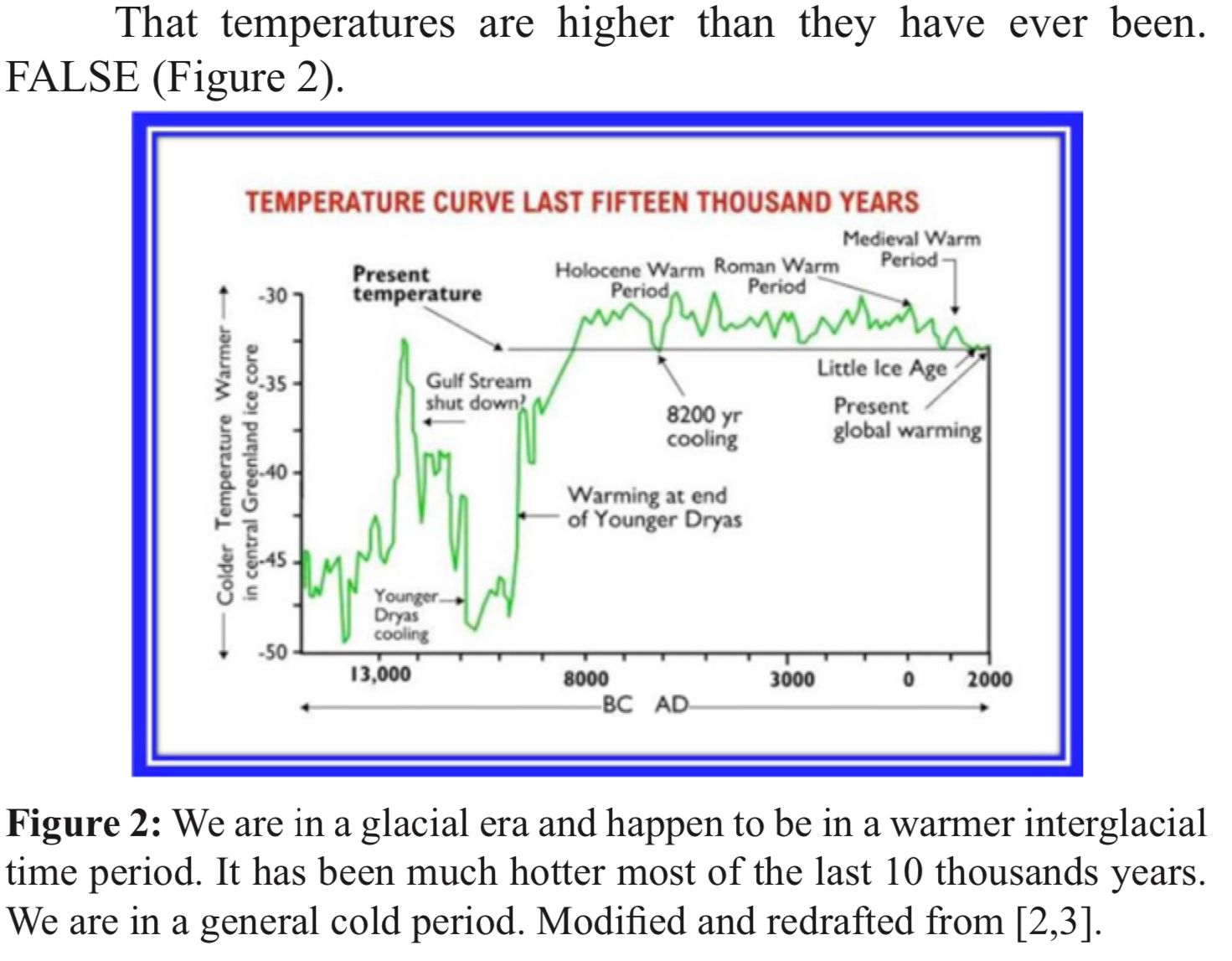
  • temperatures are higher than they have ever been. FALSE.   
  • there are more hurricanes FALSE
  • there have been more droughts: FALSE
  • there have been more wet seasons: FALSE
  • the strength of hurricanes has increased: FALSE
  • the number of violent hurricanes has increased: FALSE
  • CO2 is the major Greenhouse Gas: FALSE
  • CO2 increases will drive temperatures to catastrophic levels: FALSE
  • CO2 is the main driver of temperature increases: FALSE
  • CO2 levels today are higher than they have ever been: FALSE
  • sea level is rising: TRUE
  • the rate of sea level rise is increasing: FALSE
  • changes in solar irradiance can be ignored: FALSE
  • we can ignore the effects of the sun: FALSE
  • we can ignore sun spots: FALSE
  • CO2 is a pollutant: FALSE
  • Temperature and CO2 go up together: FALSE
  • Models can be used to predict climate: FALSE
  • the pause in temperature increases is not real.FALSE
  • there is a 97% consensus that humans are causing the climate to change: FALSE

I won't reproduce all the arguments they provide but here are a couple of the diagrams supporting their case. They also provide a comprehensive list of references. 


After reading this paper it becomes very difficult to sustain the "climate emergency" mantra of many a climate zealot.  Consider the possibility that the Climate Change theory is just wrong. That there is no climate emergency. That the current warming has been a totally natural increase due to the earth coming out of a cold period due to solar cycles. That the temperature will level off and decrease as the next cold cycle kicks in. Consider the upheaval the Climate Change theory has created. Massive changes in infrastructure, the transformation of manufacturing industries, destructive mining for rare minerals for solar panels, and massive increases in the cost of living by swapping low-cost FF energy sources for expensive intermittent renewables. It could have been all for naught. A sobering thought.


Monday, 18 March 2024

Questioning the Climate Catastrophe dogma


Is the wind changing on Climate change zealotry?  It started with the Russia-Ukraine war when much of Europe realised that renewables plus imported gas were not a very practical way of powering a modern economy. As a consequence, we have had rapid and concerted moves to refresh old coal mines, import gas and coal from sources other than Russia and renewed investment in nuclear. Green parties in several countries have re-classified nuclear energy as,  lets call it, 'Green', but I am not sure whether they actually called it 'renewable'. I guess this is no worse than advocating the burning of wood, be it re-constituted shaved, pulverized and compressed, but still plain old wood to you and me, as a renewable resource. After all, it does renew even if it happens to take decades or even hundreds of years. Of course, the same argument could be used to classify coal as renewable, but then again the periods are admittedly an order of magnitude longer.

So perhaps it is not surprising, that the 'science' behind the Climate Zealotry is also under pressure. Articles that question the very basis of Climate Change are beginning to break the defensive wall that has prevented even minor criticism of climate catastrophist dogma. The most recent that caught my eye is a rather in-depth article in the Epoch Times. The title is provocative enough Scientists Expose Major Problems With Climate Change Data.  The article lists several scientists who signed a petition called the European Climate Declaration, sceptical of human-induced global warming.

A small move but significant in its very existence.


Thursday, 7 March 2024

The Electric Con Explained - William Levin


In The Electric Car Con Explained William Levin exposes some inconvenient facts for the Climate Change zealots who are promoting electric cars as a solution to car emissions.

Here’s a short summary (courtesy Bing) but please follow the link above for the full article.
  • The U.S. car fleet accounts for only 1.0% of global energy demand (5% x 19%), which is projected to decline to 0.8% by 2050.
  • Even if the U.S. transitions to 100% electric-powered cars, the maximum climate impact in 2050 would be a mere 0.2% reduction in global CO2 emissions from the current electric grid.
  • This impact could increase to a maximum of 0.5% if solar, wind, and hydro can power 60% of electric demand, which is unlikely due to practical challenges.
  • Government mandates to switch to electric cars lack a factual basis for a significant impact on global CO2 emissions.
  • While Levin acknowledges that EVs have their place, he notes market distortions caused by subsidies and regulatory force are problematic, especially when EVs don’t suit most personal-vehicle needs outside urban areas.

1Read more from American Thinker


Saturday, 17 February 2024

Why is the CSIRO lying to us?

Our ever-zealous Minister for Climate Change, Mr Chris Bowen, is incessantly reminding us that Nuclear is the most expensive source of energy. Is this possibly true? Well, it seems not. A recent short YouTube video titled More misinformation from CSIRO on Nuclear calls out the lie, or should I just call it 'disinformation'. 


Chris Bowen's justification relies on the CSIRO's Annual Gencost report that does indeed claim Nuclear is the most expensive form of energy. The problem is that the CSIRO did NOT investigate the nuclear option with the same objective analysis it provided for Wind and Solar. It based its costings on a single SMR (Small Modular Reactor) with a large development cost. However, it did not consider full-scale Nuclear or indeed small-scale Nuclear, which has many implementations around the world. Tried and true technology, available and with predictable costing. In fact, CSIRO did not even explore the nuclear option with experts in the field. They relied on input from renewable energy providers and even government bureaucrats. 

If that weren't enough, the CSIRO has also been caught 'misinforming' us about the costs of the pumped hydro technology. This time understating the cost of such technologies.

Again a short video of the senate hearing provides the background. The video is titled CSIRO’s GenCost is Just a Wind and Solar Fairy-tale! and covers the incisive questions by Senator Roberts. Thank you senator for speaking up.


So there you are. It seems our CSIRO is no longer a respectable objective presenter of scientific research, but an advocate of a preferred technology and willing to tilt the objective truth to push an agenda. Shame! Shame!

Sunday, 24 September 2023

The Sunlight Shuffle: John Clauser's Revelation Shakes up Climate Models

In the world of climate science, where intricate models strive to predict our planet's future, John Clauser, a Nobel Laureate in Physics, seems to have struck gold. He's unveiled a critical flaw in existing climate models, one that hinges on the assumption that the amount of sunlight reflected back into space remains constant. But as Clauser adeptly points out, in reality, this assumption doesn't hold water due to the ever-changing nature of cloud cover. 

 Let's delve into Clauser's revelation and why it's causing waves in the climate science community. 

The Achilles' Heel: Variable Albedo

The cornerstone of many climate models is the concept of albedo, which is the measure of how much sunlight is reflected back into space. These models often rely on the simplifying assumption that albedo remains constant. However, Clauser's astute observation challenges this notion by highlighting the variability of cloud cover. 

Cloud cover, on average, oscillates between 30% to 70%, and it's incredibly erratic. What's more, cloud cover acts as a negative feedback loop that helps stabilize Earth's temperature. As temperatures rise, evaporation from the oceans increases, leading to greater cloud formation. This, in turn, augments the proportion of sunlight that gets reflected back into space. It's a self-adjusting system, and climate models that overlook these variations are bound to falter. 

Water Vapor: A Game-Changer 

Clauser's insight doesn't stop at variable albedo. He emphasizes the immense influence of water vapor as a greenhouse gas. Surprisingly, water vapor has a much more significant impact on temperature compared to methane or carbon dioxide, approximately 200 times greater. Yet, many of the Intergovernmental Panel on Climate Change (IPCC) models tend to downplay the role of water vapor.

Reality vs. Models 

The implication of Clauser's findings is profound. Climate models that neglect variable albedo, particularly cloud cover variations, are fundamentally flawed. They fail to accurately predict past temperatures, let alone future climate scenarios. This revelation challenges the popular narrative of a climate emergency, suggesting that it might be based on models that do not faithfully reflect reality.

Censorship and Controversy

Predictably, Clauser's declarations stirred controversy, resulting in his suppression in mainstream media and by major tech companies. 

His insights, however, are not entirely hidden; those interested can watch his full talk on EpochTV, though it's behind a paywall. (https://www.theepochtimes.com/epochtv/nobel-laureate-john-clauser-there-is-no-climate-emergency-climate-models-miss-one-key-variable-5486017), and there is a shorter version on YouTube at


In conclusion, John Clauser's revelations force us to reevaluate the foundations of climate science. The assumption of a constant albedo, without accounting for variable cloud cover, has created a rift between climate models and real-world observations. Furthermore, the substantial role of water vapor in climate change adds another layer of complexity that many models disregard. While Clauser's views have been met with skepticism and censorship, they open the door to important discussions about the accuracy of climate models and the narratives surrounding the climate crisis.

Tuesday, 13 February 2018

Is Climate Change Falsifiable?

I have seen many, perhaps too many, critiques of climate change to remain a convert. For some time now I have been sitting on the sidelines weighing the arguments (see my earlier posts ) and leaning increasingly to skepticism.

Most recently I came across an older video, on the skeptical side, that brought up what I think are most pertinent points often glossed over by the zealots.

The video is rather long, covering a presentation titled "A funny think happened on the way to Global Warming" presented by Steven F Hayward . If you have the time you can watch the whole video.


I found two areas compelling. The first is where Hayward covers the so called 97% consensus, and in particular where he quotes from the abstract of John Cook's paper. If you have followed this saga it was Cook who published a paper that lead to the 97% consensus myth. (If you are inclined you can read the paper here - Quantifying the consensus on anthropogenic global warming in the scientific literature )

I guess for anyone debating this mythical 'consensus' it is worth seeing how this 97% figure was derived. Here is the abstract to the above paper.


Abstract

We analyze the evolution of the scientific consensus on anthropogenic global warming (AGW) in the peer-reviewed scientific literature, examining 11 944 climate abstracts from 1991–2011 matching the topics 'global climate change' or 'global warming'. We find that 66.4% of abstracts expressed no position on AGW, 32.6% endorsed AGW, 0.7% rejected AGW and 0.3% were uncertain about the cause of global warming. Among abstracts expressing a position on AGW, 97.1% endorsed the consensus position that humans are causing global warming. In a second phase of this study, we invited authors to rate their own papers. Compared to abstract ratings, a smaller percentage of self-rated papers expressed no position on AGW (35.5%). Among self-rated papers expressing a position on AGW, 97.2% endorsed the consensus. For both abstract ratings and authors' self-ratings, the percentage of endorsements among papers expressing a position on AGW marginally increased over time. Our analysis indicates that the number of papers rejecting the consensus on AGW is a vanishingly small proportion of the published research.

There are many critiques of this study so I won't labour the point, but the widespread reference to a "97% consensus" shows how statistics can be used "by knaves as a trap for fools" , or indeed that there are "lies, damn lies and statistics".

The second part of the presentation that struck me was his quotation from the IPCC report of 2013 (Climate Change 2013 - Working Group Contribution to the Fifth Assessment Report of the IPCC) .

In particular the admission that uncertainty in the simulation of clouds results in cloudy (sorry about that one) predictions. Here is the actual quote; - 

"In summary, despite modest improvements there remain significant errors in the model simulation of clouds. There is very high confidence that these errors contribute significantly to the uncertainties in estimates of cloud feedbacks (see Section 9.7.2.3; Section 7.2.5, Figure 7.10) and hence the spread in climate change projections reported in Chapter 12. ( see Chapter 9, Page 782,)

and most significantly the qualification about the nature of these climate model projections,in that ;-

" these projections were not intended to be predictions over the short time scales for which observations are available to date" (Chapter 9 page 825 )
In other words you cannot dismiss a model as being inadequate if it happens to predict incorrectly in the near term, as it was designed to predict for the long term.

Really?!!

This highlights a fundamental problem with the Climate Change dogma.

Any scientific hypothesis that 'the world's climate is warming in response to anthropogenic Carbon Dioxide emissions' must be falsifiable.  Yet it seems for the many CC zealots the very idea that CC can be falsified by observations is totally out of question. If observations contradict climate models' predictions, new heretofore unknown scientific causes must be at work. For example the observation of a 'pause' in temperature increases over two decades, presented a problem until new theories of heat captured by the ocean were rolled out to a gullible populace. If indeed the heat was to be captured by the oceans shouldn't the models have predicted that in the first place? And why hadn't the oceans captured the heat of earlier decades?

Not surprisingly any record setting hot days are used as clear proof of global warming, but record setting cold days, as currently being experienced by many parts of the globe this Northern winter, are also claimed as examples of global warming. How are both possible?  No doubt some new ideas will be sought and found, but the audience is becoming skeptical.

My single question to the CC zealots remains - tell me what would prove your hypothesis wrong?

Tuesday, 6 February 2018

The inconvenient truth about climate models

Not really new, but certainly well explained, this video from PragerU highlights the the problem with today's Climate Models. The problem is simply they do not work. Their predictions have invariably been proven wrong. This is not surprising as the models are very much simplifications omitting some factors that are significant determinants of climate, eg clouds.


Yet if the models are wrong then all the consequences of following them are also wrong. Food for thought!

Wednesday, 27 September 2017

The science is NOT settled

The headline "It's worse than they thought: Warming is slower than predicted" (by Christopher Monckton) was enough to perk my curiosity.
Great headline, good story, though admittedly awash with technical details that make it hard to follow. Still I waded through to the end. In case you don't have the patience a potted summary goes like this; -

  • Monckton uses the figures in that paper together with IPCC models to demonstrate that the models are not only slightly out, but way out.  For example he cites that the measured global warming since 1850 is ~ 1 C(degree) whereas models predict this to be 2.75 C
  • The current rate of warming is ~ 0.45C per century and with predicted increases in CO2 over the period , with some assumptions that you will have to read through yourself, the 1.5C target increase in global temperature by 2100 may be achieved without any mitigation efforts.

 It all leads to a rather stunning conclusion;-

"Though the Millar paper serves to conceal the true extent of the official exaggerations on which demands for “climate action” have been unwisely based, it is at another level an early crack in the dam that indicates that the entire edifice of nonsense is about to fail. Have courage! The truth that global warming will be small, harmless and net-beneficial will soon prevail over the screeching extremists. The Millar paper is not the beginning of the end, but it is at least the end of the beginning."

Well we will see. But one thing is sure, "the science is NOT settled"!

Friday, 25 August 2017

Thorium nuclear experiments in Europe

Thorium nuclear power has been widely touted as the ultimate solution to our world's energy needs.  ( see my earlier posts What the Heck is Thorium, Thorium nuclear update). Although a very successful small scale Thorium reactor operated for a decade at Oak Ridge in the 60s, there has been virtually no further development on such reactors after the decision by the US to favour the Uranium Light Water reactors. Until now! In a first step to what is potentially the clean energy future Dutch Firm NRG has commenced a series of experiments to test various reactor design options, with the view to re-start industry. For details see "Finally, the World's First TMSR Experiment on over 45 Years has started".

Yes it is a small step, but a step it is. Watch this space...

Sunday, 13 August 2017

Baseload Equivalence Test

Putting political issues to one side, consider the energy equation. The three critical factors are ; 
  • Energy security - electrical energy must be available whenever and in whatever quantity required on a continuous basis for both industry and for households.
  • Energy costs- must be as low as possible to ensure the quality of life of individuals and households and to make industry productive
  • Emissions - Energy generation should as much as possible ensure emissions of GHG are minimal.
Real energy security requires continuous supply. Anything less is not acceptable to Australia, or indeed any country worth its salt in the 21st century.

Hence all suppliers of energy should be required to meet a Base-load Equivalence Test, BET.


BET requires every energy supplier to provide continuous supply. For example for solar, in a region where daily sunshine can provide the equivalent of 6 hours of supply (averaged over normal climatic conditions) the supplier would have to source an additional 18 hours of base-load power per day. Only by adding this base-load power could the energy supply for intermittent energy sources be regarded as 'equivalent'  to continuous supply alternatives.

Suppliers of intermittent energy such as solar or wind could meet the BET by battery or pumped hydro, or by sourcing base-load power from other suppliers. Where such supply was externally sourced it would have to be backed by formally agreed long term supply contracts. No doubt this would add to the cost of intermittent renewables, but without BET any energy supply management process, such as Finkel's CET or the older RET, is flawed.

Friday, 11 August 2017

Inconvenient facts on Climate Change

Are Climate change advocates lying about temperature records? It seems they are fiddling the evidence to omit "inconvenient facts.  In a recent article title "US Climate Report Edits Out Highly Embarrassing Section" Paul Homewood details the changes in the  3rd and 5th draft reports of the US Global Change Research Program Climate Science Special Report (CSSR). You can follow the details from the full article but it really comes down to these diagrams that have been omitted from the most recent draft report.


The above map depicts the difference between the average for 1986-2015 and the average for 1901-1960. Orange dots indicate increasing average temperature in the more recent range, and blue dots indicate decreasing average temperature in the more recent range

The following graph of maximum temperatures is equally telling.


It shows the hottest temperatures averaged over the US in the respective years. It clearly highlights that the maximum temperatures were much higher in the 20s and 30s than recently.

These fly in the face of the alarmist dogma. 

Tuesday, 18 July 2017

SA renewables crisis goes viral

In his recent insightful article in Townhall, Paul Driessen calls it how it is "Insanity and Hypocrisy Down Under". Our energy chaos has made it to the world stage!

What do you call the willful destruction of the quality of life of your own citizens without any measurable benefit from your actions? Insanity! Our State, and to some extent our Federal, governments have sacrificed energy security and price in favor of tokenistic emissions targets. Targets that, even if met, will not make one iota of difference in the temperature of the planet in 85 years. Insanity. Shutting down coal fired power stations in Australia and exporting the coal to be burnt overseas. Insanity! State governments setting renewable energy targets so onerous that continuous supply is unlikely. Insanity! The very same state governments preventing further exploration for new natural gas resources that could provide low emission base-load energy. Insanity!

Yes Driessen called it - Insanity. It is hard to argue otherwise.

The best that can be said for our insane energy policies is that it has given some warning to the rest of the world. If you follow the same renewables-uber-alles policies you will end up with spiking energy prices and blackouts, with the consequent burden on citizens and industry.

You have been warned.

Saturday, 15 July 2017

Climate change debate heats up

With Finkel's energy report sitting on the shelf for weeks, the government is under increasing pressure to come to some sort of decision on the Clean Energy Target. Given the political fall-out whichever way they turn, it is no wonder they have been vacillating

Then there's South Australia's self-inflicted energy crisis, with intermittent electricity supplied at the highest prices in the world! The state is now receiving an injection of new-technology bravado with Elon Musk 's 100MW battery farm to be completed in 100 days or your money back. Great for headlines, and depending on your disposition, a great 'up-yours to coal' or simply 'lipstick on a pig'. I guess we will see.

If that was not enough, Mr Climate Change himself, Nobel laureate, almost POTUS, Big Al Gore landed in Aus last week to promote his latest Global Warming Disaster film. Naturally the climate skeptics came out in force to remind us of some inconvenient truths about his first film, that it was banned from British schools lest its blatant untruths corrupt the minds of minors.

Everywhere you turn it seems energy policy and Climate Change are once again taking centre stage.

Yes Climate Change is hot again, but not quite as hot as it has been. It seems to me the deniers are gaining traction. Even John Howard has been reported to say that he is "today more skeptical of the science". The news is not that he is more skeptical, but that he was reported widely to have said so. I note however that the ABC's AM program last Friday, despite reporting widely on his recent comments, selectively omitted his skepticism on Climate Change. In some ways this is flattering to elder statesman Howard, an implicit recognition by the doyens at the left-leaning public broadcaster that his very words may spread this denier-virus to listeners. Heaven-forbid, lets just leave it out. Fake news by omission?

While Gore's film no doubt will receive wide audiences and plaudits from the believers, what about the skeptics. Well it seems the skeptics have fought back with a documentary of their own, "Climate Swindle". It will be shown in some theaters, though my guess is that it will receive scant attention from mainstream movie outlets. Nevertheless another movie length documentary, perhaps an earlier version from 2011 called  "The great Global Warming Swindle" is available, free of charge on You-tube. It presents a compelling case against Anthropogenic Climate change.

In summary Climate Change believers claim; -

1. Global Warming is real
2. It is man-made caused by excessive emissions of greenhouse Gases primarily Carbon Dioxide.
3. It is dangerous, threatening life, living standards and potentially global catastrophe
4. If we act decisively and collectively we can do something about it.

In "the Great Global Warming Swindle" skeptics argue; -
1. Climate change is real with cyclical warming and cooling. The earth is currently in a warming cycle that started following the "little Ice Age" of the 17th century.
2. The warming is NOT caused by Carbon Dioxide, but by natural Solar cycles. They argue that increase in Carbon dioxide is dominated by release of Carbon Dioxide from the oceans and it occurs as a result of global warming rather than as its cause.
3. Given well documented history showing periods of much high global temperatures and much higher carbon dioxide than today with abundant life, such changes are not dangerous to life on earth on the contrary a greener warmer wetter world is more fertile.
4. Given there is no problem there is not reason to do anything about it. On the contrary the attempts to limit fossil fuels are doing enormous harm, especially in the developing world, by increasing energy costs.

Here is the film judge for yourself.


Monday, 10 July 2017

Put Energy Security first !

Once again the Turnbull government is in a mess largely of its own making. It needs to decide on how it will react to the Finkel report ( Blueprint for the future:Independent Review into the Future Security of the National Electricity Market), a report it commissioned. It can either accept the key recommendation to establish  CET (Clean energy target) of some 42.5% (much greater than the current 24% RET) and accept the already high an dlikely increasing energy costs as well as the instability in supply or it can reject the key recommendations reneging on its emission reduction commitments and renewable energy targets and in effect rejecting the recommendations of its own report. With passions high in both sides there is no doubt there are electoral consequences to this decision. 

However I can see no way of avoiding conflict and with vocal proponents of each side it is likely to be loud. 

Avoiding Finkel's poisoned chalice

So lets just put the political issues to one side and consider the energy equation. The three critical factors are ; 
  • Energy security - electrical energy must be available whenever and in whatever quantity required on a continuous basis for both industry and for households.
  • Energy costs- must be as low as possible to ensure the quality of life of individuals and households and to make industry productive
  • Emissions - Energy generation should as much as possible ensure emissions of GHG are minimal.
Finkel's report is grossly inadequate. By focusing on Emissions targets and how existing global commitments may be met, the report sacrifices the other two critical factors.

Finkel does recognize energy security as a key issue and sensibly proposes that suppliers of intermittent renewable energy be required to provide base-load power as a backup. However by limiting the backup power required to a mere 90 minutes his proposal does not provide anywhere near adequate cover. In effect he papers over this very real limitation of the most popular renewables, solar and wind. 90 minutes is totally inadequate should a South Australia style event recur.

Real energy security requires continuous supply. Anything less is not acceptable to Australia, or indeed any country worth its salt in the 21st century.

Hence all suppliers of energy should be required to meet a Base-load Equivalence Test, BET.


BET requires every energy supplier to provide continuous supply. For example for solar, in a region where daily sunshine can provide the equivalent of 6 hours of supply (averaged over normal climatic conditions) the supplier would have to source an additional 18 hours of base-load power per day. Only by adding this base-load power could the energy supply for intermittent energy sources be regarded as 'equivalent'  to continuous supply alternatives.

Suppliers of intermittent energy such as solar or wind could meet the BET by battery or pumped hydro, or by sourcing base-load power from other suppliers. Where such supply was externally sourced it would have to be backed by formally agreed long term supply contracts. No doubt this would add to the cost of intermittent renewables, but without BET any energy supply management process, such as Finkel's CET or the older RET, is flawed.

Frydenberg's get out of jail card...

Given the potential political consequences it is no wonder that the government has been vacillating on their response to Finkel.

By putting Energy security first there is a sensible path through this dilemma   

Step 1: Clearly state that of the 3 conflicting needs identified by Finkel, Energy security is the first priority.

Step 2: In order to ensure all energy supply alternatives are comparable when it comes to energy security, all new supply will have to meet the Base-load Equivalence Test to provide 100 percent continuous energy. Solar and wind will have to either purchase base-load power from other suppliers or add their own battery, pumped hydro or other base-load power solutions hydro.

Step 3: Reject CET, retain the RET, accept the possibility that the current emissions reductions and renewable energy targets may not be met, but argue that Australia cannot afford to jeopardize energy security.

While the above three address the immediate problem, they do not re-build the shortage of base-load power following closures of coal fired generators over the past decade. Nor is it likely, given the current political environment, that commercial operators will build new base-load power generators. So the government needs to step in with Step 4.


Step 4: Commit federal funds to building new base-load power stations to compensate for closures over the past decade. The government would supply this energy at commercial rates and in competition with other suppliers, and be willing to sell the asset once it was proven to be competitive. Given current electricity prices and the re-balancing of demand due for base-load power due to the need to meet BET, in all probability these power stations will be able to be sold off at a profit.

Look to the electorate

Any proposal that is willing to sacrifice Australia's commitments to GHG reduction or indeed the RET is likely to receive widespread condemnation by the Chatterati. However Australian Industry and households will accept it as a fair compromise. This is especially so given that Australia's contribution to global warming is minimal and any effort we could make is dwarfed by the increasing emissions by China and India.