Welcome

Welcome to Grappy's Soap Box - a platform for insightful commentary on politics, media, free speech, climate change, and more, focusing on Australia, the USA, and global perspectives.
Showing posts with label #climatechange. Show all posts

Wednesday, 22 April 2026

The Heat Myth: What the Data Actually Shows


A newly published paper in *Springer Nature’s journal Theoretical and Applied Climatology is raising uncomfortable questions for the dominant climate narrative.

The study—by climatologist John R. Christy—does something refreshingly simple: it looks at actual observed temperature extremes across the United States from 1899 to 2025.

No modelling.
No sweeping global averages.
Just raw, station-based data.

And the results? They contradict what we’re constantly told.

What the Study Actually Did

The paper (titled Declines in hot and cold daily temperature extremes in the conterminous US) analysed:

  • Daily maximum temperatures in summer

  • Daily minimum temperatures in winter

  • Covering over a century of observations (1899–2025)

  • Using real station data, not heavily adjusted or homogenised datasets (newswise.com)

In other words, this is about temperature extremes—the events people actually feel—not abstract averages.

The Key Finding: Extremes Were Worse in the Past

The headline result is striking:

  • The most extreme heat events in the US occurred in the early 20th century, particularly the 1930s

  • Both hot and cold extremes have generally declined over time

  • The overall pattern shows a moderation, not escalation, of temperature extremes

Yes, you read that correctly.

According to this dataset, the United States experienced more intense temperature swings decades ago than it does today.

The 1930s: America’s Real Heat Crisis

If you want a period that truly tested the limits of heat in the United States, look no further than the Dust Bowl era.

Image

Image


That decade saw:

  • Record-breaking heatwaves

  • Widespread agricultural collapse

  • Extreme drought conditions

And—crucially—these events still dominate many all-time temperature records today.

So Why Does the Narrative Feel So Different?

Here’s where things get interesting—and controversial.

The paper deliberately avoids heavy data “adjustments” and instead relies on observed station data. That matters because:

  • Many global datasets use homogenisation techniques to adjust historical records

  • Urbanisation can introduce heat biases over time (more concrete, less vegetation)

  • Modern reporting focuses heavily on averages, not extremes

This study flips that focus and asks a simple question:

What do the raw extremes actually show?

And the answer is: less volatility, not more.

But Let’s Be Clear… This Isn’t the Whole Story

Before anyone jumps to conclusions, it’s important to keep perspective.

This paper:

  • Focuses on the United States only, not global temperatures

  • Examines extremes, not long-term average warming trends

  • Uses a specific methodological approach that differs from many mainstream datasets

So while it contradicts claims about extreme temperatures and rising volatility, it doesn't overturn the entire narrative relating to climate change. Yet given these observations one must hold all extreme climate claims up to scrutiny.

Why This Matters

What this paper really exposes is something deeper:

A growing disconnect between:

  • What people are told

  • And what specific datasets actually show

Climate science is complex. But public messaging often isn’t.

And when a peer-reviewed paper suggests that the worst heat extremes occurred nearly a century ago, it raises a legitimate question:

Are we getting the full picture—or just the most convenient version of it?

The Bottom Line

The new study doesn’t deny climate change.

But it does challenge a commonly repeated claim:

That recent years represent an unprecedented explosion in extreme heat—at least in the United States.

According to this research, the truth is more nuanced:

  • The past—especially the 1930s—was more extreme than many realise

  • And today’s climate is more stable in terms of extremes than the headlines suggest

Which leaves us with a simple takeaway:

Before accepting sweeping claims about “unprecedented” conditions, it might be worth asking—unprecedented compared to what?

Tuesday, 10 February 2026

Climate Alarmism's Dirty Secret

For decades we have been told to “trust the science.” It is a powerful phrase, designed to end debate rather than invite it. But science, real science, does not fear scrutiny. It welcomes it. And that is precisely why the growing evidence of weather and climate data manipulation should concern everyone — including those who genuinely care about the environment.

A recent YouTube presentation (linked below) lays out, in clear and troubling detail, how historical weather data has been altered, adjusted, homogenised, and in some cases outright rewritten to manufacture a narrative of accelerating climate catastrophe. The presentation is uncomfortable hearing not because it is radical, but because it is meticulous.

This is not a denial of climate change. The climate has always changed. It always will. The issue here is whether the data we are shown has been massaged to fit a predetermined conclusion, rather than conclusions being drawn from unaltered data.


From Measurement to Manipulation

Weather stations used to be simple, consistent instruments. Many were placed away from urban heat sources, measured manually, and maintained with care. Over time, however, measurement practices changed:

  • Weather stations were relocated closer to urban areas

  • Surroundings became increasingly built-up

  • Measurement techniques changed

  • Historical data was “adjusted” to align with modern models

Each of these changes introduces bias. Taken together, they can dramatically distort long-term temperature trends.

Yet instead of clearly flagging these limitations, climate authorities routinely retroactively cool the past and warm the present, exaggerating warming trends. There are multiple examples where raw historical data shows modest or flat trends — until it is “corrected.”

Corrected for what, exactly? Often, the justification is vague, opaque, or circular.

The Vanishing Past

One of the most damning aspects highlighted is the systematic disappearance of inconvenient data.

Stations showing little or no warming are quietly removed from datasets. Older records that contradict modern alarmism are re-interpreted or discarded. Meanwhile, newer stations — often located near airports, asphalt, air conditioners, and expanding cities — dominate the averages.

This is not how honest science behaves.

If the climate case is as overwhelming as claimed, it should stand on raw, transparent data. Instead, we see gatekeeping, obfuscation, and appeals to authority.

Models Over Reality

Another key issue raised is the elevation of computer models above observed reality. Models are useful tools, but they are only as good as their assumptions. When observations diverge from models, the models should be questioned.

Instead, what we increasingly see is the reverse: observations are “adjusted” to better match the models.

That is not science. That is narrative enforcement.

Why This Matters

This manipulation matters because it underpins policies that affect every household:

  • Rising energy costs

  • Reduced reliability of power grids

  • Increased cost of living

  • De-industrialisation and offshoring

  • Reduced national resilience

If societies are being asked to accept economic pain, reduced living standards, and sweeping government intervention, the justification must be rock-solid. Not politically convenient. Not selectively curated.

When data is manipulated to scare the public into compliance, trust is destroyed — not just in climate institutions, but in science itself.

Skepticism Is Not Heresy

Questioning data is not denialism. It is the foundation of science.

The disturbing reality exposed in this presentation is that dissent is no longer debated — it is silenced. Critics are smeared rather than answered. Data is hidden rather than defended.

That should worry everyone, regardless of where they sit on climate policy.

Because once data becomes a political tool, truth is no longer the goal.

Watch the Full Presentation

I have included the full YouTube video at the bottom of this post. I strongly encourage readers to watch it in full and judge the evidence for themselves.

If the climate narrative is as robust as we are told, it should survive transparency.

If it cannot — then the real crisis is not the climate, but the corruption of science itself


Tuesday, 16 September 2025

Climate Alarmism Without Justification

The Albanese government has just released its First National Climate Risk Assessment Report. It is everything you might expect: page after page of dire predictions, speculative scenarios, and warnings of massive economic damage unless Australia acts swiftly and decisively against climate change.

The message is unmistakable — if the government does not take “serious action” to reduce emissions, the cost to the economy will be catastrophic. It is fear-mongering, plain and simple. The report is designed not to inform, but to soften the ground for the government’s upcoming release of its 2035 emission reduction targets.

But here’s the problem. Here’s the fallacy that cuts through the entire exercise.

Australia produces just 1.3% of the world’s emissions. That’s it. One point three. Even if Australia were to shut down tomorrow, wipe itself off the map, and send its population into the sea, the effect on the global climate would be negligible.

Which makes the government’s economic scare campaign utterly dishonest.

They imply that unless we act, we will suffer the costs of climate change. But whether Australia acts or not makes virtually no difference to the global climate. If China, India, the US, and other large emitters continue to grow their emissions, Australia’s sacrifice is meaningless.

And sacrifice is what it is. Every new emissions target means more cost, more subsidies, more restrictions, more distortion of the energy market, and more economic drag. Every dollar spent in the name of “mitigation” is a dollar that makes Australia poorer, without delivering any measurable benefit to the climate.

This is the central point the Albanese government never admits: there is no economic justification for emission mitigation in Australia because we cannot change the outcome. All we are doing is hobbling ourselves while the rest of the world carries on.

Sky News rightly described Labor’s climate policy con as the “biggest drag on the economy.” But the even greater con is that Australians are being told that our sacrifices will save us. They won’t.

This Climate Risk Assessment is just another political tool — a glossy report filled with scary scenarios to justify policies that will cost us dearly while achieving nothing.

It is fear without logic. Cost without benefit. Sacrifice without purpose.

And Australians should not be fooled.

Chris Kenny of Sky News covers these points in his own way in the following YouTube video, well worth a view.


Monday, 30 June 2025

Australia's self-inflicted energy disaster

With virtually daily bombshell news hijacking all media focus, climate zealotry has not had its share of attention. You may not have heard about the recent presentation highlighting Australia's poor energy policies. As part of his sold-out Australian tour for the Institute of Public Affairs, US author and filmmaker Robert Bryce spoke in Sydney about why Australia needs to pull "the plug on Net Zero. Adam Creighton and Chris Uhlmann, both journalists for The Australian, joined Robert Bryce in presenting the case with compelling arguments.

Together, they provided an incisive critique of Australia's current energy policies, highlighting the pitfalls of the country's commitment to net-zero emissions by 2050.

Australia's Energy Failure

Bryce highlights the paradox of Australia being an energy-rich nation that exports vast quantities of coal, natural gas, and uranium, yet faces domestic energy shortages. He points out that while Australia is the world's third-largest LNG exporter, it experiences gas shortages at home due to infrastructure constraints and policy decisions. Similarly, despite possessing significant uranium reserves, Australia has no nuclear power plants, limiting its options for low-emission, reliable energy.

Critique of Net-Zero Ambitions

The presentation challenges the feasibility of achieving net-zero emissions, arguing that such goals are more aspirational than practical. Bryce emphasises that Australia's contribution to global CO₂ emissions is approximately 1%, questioning the rationale behind policies that could have minimal global impact yet significant domestic economic consequences.

Key Insights from the Presentation

Bryce presented several slides that demonstrate the absurdity of Australia's policies. Here are a few of them.

  • Australia's contribution to world emissions is insignificant


  • China and India's increase in emissions is much greater than the reductions in emissions in the rest of the world.


  • Coal is NOT being phased out. The growth in coal-fired capacity is five times greater than the growth in nuclear capacity.


  • Australia's coal-fired generation is insignificant, so why close them prematurely?


  • World experience shows that cheap alternative energy is a myth.


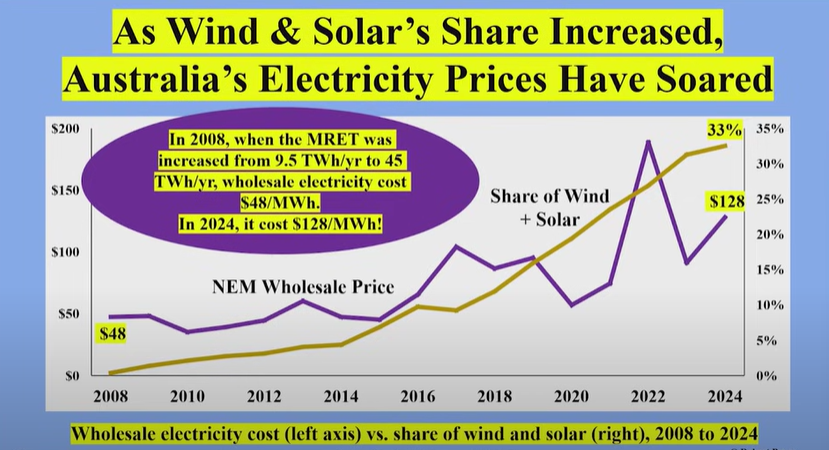
  • Renewables (solar and wind) cause increases in electricity costs


  • Net Zero is very expensive


In summary
Given Australia's relatively insignificant contribution to global emissions, energy policy should be driven by cost and efficiency. Australia's Net Zero target should be abandoned as it is unattainable, and attempts to implement it will cause damage to Australia's economy without yielding any benefits in terms of global emissions reduction. The drive towards Net Zero would be self-inflicted harm.


Watch the Full Presentation


Friday, 11 August 2017

Inconvenient facts on Climate Change

Are Climate change advocates lying about temperature records? It seems they are fiddling the evidence to omit "inconvenient facts.  In a recent article title "US Climate Report Edits Out Highly Embarrassing Section" Paul Homewood details the changes in the  3rd and 5th draft reports of the US Global Change Research Program Climate Science Special Report (CSSR). You can follow the details from the full article but it really comes down to these diagrams that have been omitted from the most recent draft report.


The above map depicts the difference between the average for 1986-2015 and the average for 1901-1960. Orange dots indicate increasing average temperature in the more recent range, and blue dots indicate decreasing average temperature in the more recent range

The following graph of maximum temperatures is equally telling.


It shows the hottest temperatures averaged over the US in the respective years. It clearly highlights that the maximum temperatures were much higher in the 20s and 30s than recently.

These fly in the face of the alarmist dogma. 

Saturday, 15 July 2017

Climate change debate heats up

With Finkel's energy report sitting on the shelf for weeks, the government is under increasing pressure to come to some sort of decision on the Clean Energy Target. Given the political fall-out whichever way they turn, it is no wonder they have been vacillating

Then there's South Australia's self-inflicted energy crisis, with intermittent electricity supplied at the highest prices in the world! The state is now receiving an injection of new-technology bravado with Elon Musk 's 100MW battery farm to be completed in 100 days or your money back. Great for headlines, and depending on your disposition, a great 'up-yours to coal' or simply 'lipstick on a pig'. I guess we will see.

If that was not enough, Mr Climate Change himself, Nobel laureate, almost POTUS, Big Al Gore landed in Aus last week to promote his latest Global Warming Disaster film. Naturally the climate skeptics came out in force to remind us of some inconvenient truths about his first film, that it was banned from British schools lest its blatant untruths corrupt the minds of minors.

Everywhere you turn it seems energy policy and Climate Change are once again taking centre stage.

Yes Climate Change is hot again, but not quite as hot as it has been. It seems to me the deniers are gaining traction. Even John Howard has been reported to say that he is "today more skeptical of the science". The news is not that he is more skeptical, but that he was reported widely to have said so. I note however that the ABC's AM program last Friday, despite reporting widely on his recent comments, selectively omitted his skepticism on Climate Change. In some ways this is flattering to elder statesman Howard, an implicit recognition by the doyens at the left-leaning public broadcaster that his very words may spread this denier-virus to listeners. Heaven-forbid, lets just leave it out. Fake news by omission?

While Gore's film no doubt will receive wide audiences and plaudits from the believers, what about the skeptics. Well it seems the skeptics have fought back with a documentary of their own, "Climate Swindle". It will be shown in some theaters, though my guess is that it will receive scant attention from mainstream movie outlets. Nevertheless another movie length documentary, perhaps an earlier version from 2011 called  "The great Global Warming Swindle" is available, free of charge on You-tube. It presents a compelling case against Anthropogenic Climate change.

In summary Climate Change believers claim; -

1. Global Warming is real
2. It is man-made caused by excessive emissions of greenhouse Gases primarily Carbon Dioxide.
3. It is dangerous, threatening life, living standards and potentially global catastrophe
4. If we act decisively and collectively we can do something about it.

In "the Great Global Warming Swindle" skeptics argue; -
1. Climate change is real with cyclical warming and cooling. The earth is currently in a warming cycle that started following the "little Ice Age" of the 17th century.
2. The warming is NOT caused by Carbon Dioxide, but by natural Solar cycles. They argue that increase in Carbon dioxide is dominated by release of Carbon Dioxide from the oceans and it occurs as a result of global warming rather than as its cause.
3. Given well documented history showing periods of much high global temperatures and much higher carbon dioxide than today with abundant life, such changes are not dangerous to life on earth on the contrary a greener warmer wetter world is more fertile.
4. Given there is no problem there is not reason to do anything about it. On the contrary the attempts to limit fossil fuels are doing enormous harm, especially in the developing world, by increasing energy costs.

Here is the film judge for yourself.


Monday, 15 May 2017

Energy frontiers

Whether you are a strong advocate or a mild skeptic, the focus on CC has spawned widespread research for efficient low cost inexhaustible, non-polluting energy. This research is gradually bearing fruit with advances in new technologies making headlines weekly.

From time to time I have highlighted some of these in posts (see What the Heck is Thorium?, What is LENR?), and will continue to do so.

In the mean time here is a list of recent articles on some of these new technologies;-
  • Energy Storage. Intermittency is perhaps the major constraint on the use of Solar and Wind power that can be addressed by energy storage. There are many approaches and widespread research. Tesla battery technology is widely known and is gaining increasing acceptance. Vanadium based Flow batteries are less well known but potentially equally valuable. These batteries use a liquid Vanadium 'electrolyte' that can be in a charged or discharged state. It can be charged using renewable sources and if required transferred to provide power where it is needed.  (see Vanadium-Flow Batteries: The Energy Storage Breakthrough We've Needed.)
  • Nuclear. Given its low cost , proven capacity, and despite Fukushima , nuclear is developing on several fronts.
    • Mini reactors. China is starting the roll-out of factory size 300 Megawatt 'mini' nuclear reactors (see Mini Nuclear Reactor ready to be built.) The ACP100 reactors meet all IAEA safety standards and promise efficiency and safety beyond the conventional larger size reactors. China plans to start mass production for the local market with plans to later export overseas.
    • Thorium reactors.  Indonesia together with consortium ThorCon is developing novel Thorium Molten Salt Reactors for deployment in Indonesia. (see Indonesia and Thorcon to develop Thorium MSR.) For some background on the use of Thorium in nuclear reactors, see my earlier post What the Heck is Thorium?
  • Cold Fusion. Yes it is still around. See my post "What is LENR?" for an introduction and the video below gives a technical intro.


This list is by no means complete.

New energy technologies rather than Carbon taxes

With the world's energy needs rising and the concentration of energy use on fossil fuels that threaten Climate change the rewards for any breakthrough are substantial. So it is no surprise that research in new technologies is pervasive.

Despite widespread efforts by the world community to counter climate change by limiting the use of fossil fuels, their use is still rising. Poorer countries are not willing, nor should they, limit the economic prosperity of their people by using more expensive renewable technologies. I believe it is unlikely that all the global agreements on limiting "Carbon pollution" will have the desired effect.

At the same time as soon as renewable energy is cheaper than fossil fuels there will be no incentives required to encourage its use and the world will rapidly convert.  I believe this is the most likely solution to the threat of climate change and will occur with in the next decade.


Tuesday, 28 March 2017

Time to scrap RET

Today's article in The Australian by Maurice Newman "The ever-receding mirage of cheap renewables just faded from view" provides a sobering review of the consequences of ideological climate action. The consequences of decisions made when Climate Change was the "greatest moral challenge of our time".

The results of policies enacted just a few years ago are having some inconvenient consequences. In Europe and Worldwide the hysteria that led to aggressive retirement of fossil fuels in favour of renewables has gone into reverse with some 1500 coal fired plants planned or under construction today.

For Australia there is a stark reality; higher energy costs and blackouts. South Australia the champion and trailblazer of renewables has had a rude awakening. Without sufficient base-load power there will be blackouts. Even if the inter-connector could magically provide back up base-load power whenever it was required, the cost would always be high. Suppliers would always charge a premium giving priorty to their long term contracts, and only surplus energy would be made available to the 'spot' market. Given the intermittent nature of renewables this rise in costs was predictable and inevitable. Perhaps battery storage will, over time, help to address this, but it is very much at an experimental stage, while South Australia needs real solutions today.

Australia was once the envy of the world, with abundant cheap energy to power its industry and even to export. Today with its national Renewable Energy Target (RET) as well as even more ambitious, ie fool hardy, state government targets, this has all changed. The RET has distorted our energy markets. It is no longer economic to maintain or invest in new fossil fuel generation if no one is willing to commit to long term supply contracts. Our aging coal fired plants are being phased out, decreasing base-load capacity and increasing prices. The impact is on all industry through higher costs and uncertainty of supply. All this for no measurable reduction in global CO2 emissions. Australia is crippling its economy for symbolism.

It is time the government bit the bullet and scrapped the national RET and let the markets operate to provide the abundant low cost energy that gave Australia its kick-start in the industrial era.

Wednesday, 9 November 2016

Don't Panic!

I happened to catch the last few minutes of the ABC's QandA last night. The topic at the time was Climate change. It was the usual one-sided ABC panel with the usual one-sided audience clamoring for immediate action against carbon pollution. It is the greatest "moral challenge of our time", "without real action today we are facing climate disaster!" the various calls coming across as rather shrill.

Of course there was the sacrificial token representative of the 'dark' side. In this case it was James Paterson a rather youthful Victorian Liberal Senator. During the few minutes I watched he acquitted himself well, responding with commendable equanimity in the clearly hostile atmosphere.

I was struck by the passion of the climate change advocates, the foam-in-the-mouth, frothy passion, the no-argument-or-discussion-is-allowed passion, the disgust-for-anyone-wanting-to-question passion.

These are without doubt intelligent people, who on any other subject would listen to the information, seek alternate views, apply some filters as to the veracity of the information and then come to a balanced judgement. But it seems that with Climate change it is different. Yes it is a cliche to call it a religion, but I do recall from decades past I did note the same visceral passions in the occasional discussions on religion.

As I have noted in my earlier posts, my own beliefs have evolved over the past year. (See the Climate Change page for a list of my posts.) I have been swayed from the most foreboding predictions of "runaway" climate change by just a few observations.


  • The Earth's average temperature has been more than 5C degrees higher than today and yet it supported a rich biodiversity.  For example, during the Jurassic period the average temperature of the Earth was ~25C. This is a full 10C degrees higher than today. Yet during the Jurassic life was abundant. So what is so special about a 2 degree rise from the current average of ~15C. 
  • CO2 concentration has been much higher than today and yet the Earth supported abundant animal life. Again during the Jurassic CO2 concentration rose to >2500 ppm yet supported life. 
  • The historical record shows no evidence of a "tipping point". The geological record shows a wide variation of temperatures and CO2 concentrations (see Graphic above). Yet there is no evidence that there is a "Tipping point" whereby if the CO2 concentration exceeds some threshold there is a runaway temperature increase. On the contrary the geological record shows cyclical changes in temperature and CO2 concentration with most temperature higher than today. 
So lets all calm down. Yes, there is global warming. The earth has been in a steady warming period after the mini-ice age of the early 17th century. Yes, it is probable, but not certain, that man made emissions of CO2 are contributing to this warming. It is possible, but again not certain, that if our civilization can reduce its emissions, we could mitigate some of the temperature increase. Indeed it may even be worth doing this in a sensible, equitable and gradual process. After all I am all for sustainability.

But there is no need to overreact. The world will not end in a ball of fire if we fail to control our emissions. Planet earth will not turn into Venus if we fail to close brown coal power stations in Victoria next year. Nor indeed can any of our virtue-signaling state governments on their own make any measurable impact on the Earth's temperature. Neither can all of Australia. It requires a coordinated world effort to make even an iota of difference. Will such a coordinated effort occur? We are yet to see.

My expectation is that our significant investment in energy research will generate breakthrough technologies. Technologies that provide abundant base-load energy at lower cost than fossil fuels. When that happens the world will quickly shut down fossil fuel power stations without any coaxing.

We do have time. Even if the world carries on business-as-usual our civilization will survive a 3 degree increase in temperature and a doubling of CO2 concentration. Indeed it would be a warmer wetter and greener world, perhaps more pleasant that today's. 

QandA's shrill calls for no-holds-barred-urgent-action remind me of the advice printed on the "Hitchhiker's Guide to the Galaxy" , "Don't Panic!"

Sunday, 23 October 2016

Warmer, wetter and greener

This weekend's Australian featured an article by respected author and science journalist Matt Ridley (Is climate policy doing more harm than good?) and quite coincidentally I came across the YouTube video of his presentation at the Royal Society just a few days ago. However, for some reason, the video has been removed from YouTube. Should I suspect censorship? So please read the article.

Ridley's argument is most compelling. He argues for a middle road between the two extremes of the climate change debate. He presents a cogent case for a world that is warming due to man-made emissions, but at a slower rate than models have been predicting and is far from "catastrophic" but potentially heralding a warmer, wetter and greener world. 

Nor does he contradict the IPCC. Rather he demonstrates that the IPCC presents a range of outcomes depending on a range of scenarios, assumptions if you will. Therefore his own, more positive prediction is within the range predicted by the IPCC. 

I have written at some length on Climate Change, including a statement of my own position (see Credo on climate change). Since that time some 15 months ago I have read extensively on the subject both from the advocates and deniers, but admittedly I have been looking more closely at the deniers. What better way to evaluate one's position than by listening to those who disagree.

There are many , many intelligent scientists who question "the science of climate change" and for good scientific reasons. As a result I have become more skeptical and I am sensing so has the whole world.

Who knows the dire warnings of "catastrophic" climate change may go the way of many other predicted catastrophes of the past. The 1972 predictions by the Club of Rome that the world could only support 5 billion people, or again in the 70's, the prediction that the world was about to enter an Ice Age. Such predictions may garner attention and indeed funding, but are usually exaggerated.

I prefer the middle of the road, and therefore have found Ridley's position compelling.


Monday, 7 December 2015

Fly in the ointment

With the Paris climate change conference in its second week, leaks are being fed into the airwaves of a draft 'deal' with momentous import ( eg see Officials from around the world reach climate change draft agreement).

The local press has been strangely silent on the internal machinations of the many hundreds of delegates working feverishly on the details of the 'deal' that is the highlight of these gatherings. No doubt the final encyclical will be announced with great fanfare in the closing hours of the conference. As always, it will be hailed as another great step in saving the world from calamity. As always, it will take many months before the real impact of the conference is properly evaluated.

Despite all the eloquent words that have been uttered, despite the well meaning commitments of the developed world, despite the positive vibe of it, this conference, like its predecessors, will not deliver to its hype. Not that the many delegate countries will not try, nor that they will not succeed in achieving their pledged reductions. No doubt most of the developed world will try, and will succeed to various degrees. But despite these efforts there is a 'fly in the ointment'. Indeed it is more of a mammoth than a fly. It is China.

Figure 1 China is the largest emitter by far

China, the industrial behemoth that has driven world commerce for the past decade, has made no pledges to reduce its emissions.  It has committed to peak its emissions by 2030 and then reduce its carbon intensity by 60% by 2030.  Putting carbon intensity aside, China's bid is sheer chutzpah, With already by far the greatest emission rate in the world (see Figure 1), virtually double that of the US, China is not committing to reduce its emissions at all. In fact it has pledged to keep increasing its emissions year on year for the next 15 years!


Figure 2 China's per capita emissions equal to Europe's

China is not only the worlds largest emitter by a large margin, but, perhaps contrary to popular belief, its per capita emissions are not developing world standard. China's per capita emissions are equal to that of Europe, and rising (see Figure 2 above). There is no validity to claims that it needs 'special treatment' because it is a 'developing' nation, so it should accept its fair share of the effort in reducing the world's emissions.

Figure 3 China's GDP much lower than developed world


While China's GDP per person is significantly less than that of the US or Europe (see Figure 3 above), acting to reduce her emissions does not relegate her people to lower standards of living. Europe has demonstrated that a high standard of living can be achieved with a low carbon intensity. China must simultaneously reduce its emissions, grow the wealth of its citizens while maintaining its current per capita emissions.

Without China taking real and effective action there is no hope of the world achieving a 2 degree ceiling on global warming.

No matter how eloquent the words of that final resolution, without a commitment by the world's largest emitter they will be just hot air.