Welcome

Welcome to Grappy's Soap Box - a platform for insightful commentary on politics, media, free speech, climate change, and more, focusing on Australia, the USA, and global perspectives.
Showing posts with label Australia. Show all posts

Tuesday, 21 April 2026

De-escalate, De-escalate: Australia's Dalek Diplomacy


There was a time—within living memory—when Australia knew exactly where it stood.

On matters of principle, we didn’t hedge. We didn’t mumble. We didn’t hide behind process.

We stood with the West.

We stood with the United States.

And we stood—consistently and unapologetically—with Israel, a fellow democracy in a region where democracy is in short supply.

At the United Nations, Australia had a reputation. While the chamber too often descended into ritualised condemnation of Israel—year after year, resolution after resolution—Australia was one of the few countries prepared to push back. Not blindly, but on principle. We recognised the difference between democracies defending themselves and regimes exporting terror.

That clarity is now gone.

The “De-Escalate” Doctrine

Listen to the Albanese Government—particularly Foreign Minister Penny Wong—and one word dominates every conflict:

“De-escalate.”

It’s repeated like a reflex. A script. A shield.

After the October 7 atrocities carried out by Hamas—an act of mass murder that shocked the world—the first instinct from Australia’s leadership wasn’t moral clarity. It wasn’t a firm declaration of support for a democratic ally under attack.

It was… de-escalation.

Even before Israel had responded.

Fast forward to the confrontation involving Iran—where the stakes are global, not regional—and the script hasn’t changed. The United States acts. Israel acts. And Australia?

“De-escalate.”

No leadership. No conviction. No sense of who is right and who is wrong.

Just a diplomatic shrug.

What Changed?

Australia didn’t suddenly lose its values.

It elected a government that no longer prioritises them in the same way.

For decades, the alliance with the United States wasn’t just strategic—it was instinctive. Australia didn’t wait to be asked. It didn’t equivocate. When moral clarity was required, we provided it.

That era looks increasingly distant.

So what changed?

The answer sits uncomfortably within the modern Australian Labor Party.

Earlier Labor governments—whatever their faults—were anchored by the party’s right faction. Leaders like Hawke and Keating understood power, alliances, and the realities of a dangerous world. They didn’t indulge in moral fog. They made calls.

Today’s Labor Party is different.

It is dominated by its left faction—more ideologically driven, more sceptical of Western power, and far less comfortable backing allies like the United States and Israel. In that worldview, drawing hard moral lines is seen as risky. Better to soften the language. Better to hedge. Better to say nothing of consequence.

Enter Prime Minister Anthony Albanese and Foreign Minister Penny Wong.

Their now-familiar refrain—“de-escalate”—is not just a diplomatic talking point. It’s a reflection of their ambivalence. A government unsure of its footing internationally, constrained by its own ideological base, and increasingly unwilling to call out right from wrong when it matters most.

This isn’t balance.

It’s drift.

And in global politics, drift doesn’t read as neutrality—it reads as weakness.

Domestic Politics, Foreign Policy

There is an uncomfortable question sitting just beneath the surface:

Has domestic politics begun to dictate foreign policy?

Australia is a proudly multicultural country having accepted immigrants and refugees from around the world. That has long been one of its strengths.

However recent high levels of immigration from North Africa and the Middle East have imported large numbers with different political views. When voting blocs begin to shape international positioning—when leaders start calibrating moral language to avoid domestic backlash—something shifts.

Policy becomes cautious. Then diluted. Then unrecognisable.

We’ve seen versions of this play out in other Western democracies. In Canada. In the United Kingdom. Social tensions rise. Public discourse hardens. And foreign policy becomes a balancing act rather than a statement of principle.

Australia now appears to be heading down the same path.

The Cost of Saying Nothing

Let’s be clear: calling for “de-escalation” is not wrong in itself.

Of course we want less conflict. Of course we want fewer casualties.

But when that is all you say—when it replaces judgement rather than complements it—it becomes a problem.

Because silence, dressed up as neutrality, is still a position.

And in conflicts where one side is a democratic state responding to terrorism or aggression, and the other is not, refusing to draw distinctions isn’t diplomacy.

It’s abdication.

A Dangerous Drift

Foreign policy doesn’t exist in a vacuum.

It shapes how allies see us.

It shapes how adversaries judge us.

And increasingly, it shapes how we see ourselves.

If Australia becomes a country that won’t speak clearly in moments that demand clarity—won’t back allies when it counts—won’t defend the principles it once championed—then something fundamental has changed.

Not just in Canberra.

But in the national character.

Final Thought

For decades, Australia punched above its weight not through size or power, but through clarity and conviction.

I suspect that reputation is is already lost.

And once lost, it won’t be easily regained.


Monday, 6 April 2026

Zoe Booth on Israel vs Australia

"Written by Zoe Booth, and inspired by her first trip to Israel, this video explores the gap between perception and reality. 

Arriving in Israel for the first time, what she encountered challenged many of the assumptions common in Australia—from fears about safety to deeper questions about identity, cohesion, and national purpose. 

Why does Israel maintain unity despite internal tensions? 
Has Australia’s model of multiculturalism weakened social cohesion? 
And what happens when a country loses confidence in its own identity? 

Drawing on firsthand experience, this is a reflection on two very different societies—and what one might learn from the other."


Sunday, 7 September 2025

The Decline of Prosperity: An Introduction


Across the developed world, people are asking the same question: Why does life feel harder than it used to?

In the UK, Canada, and Australia — nations once known for their stability and prosperity — the signs are everywhere:

  • Rising costs of living

  • Falling real wages

  • Housing slipping out of reach

  • Protests in the streets

  • Growing distrust of government and media

It’s tempting to look for conspiracies — to imagine some shadowy force pulling the strings. But the truth, I believe, is simpler and more sobering. The decline is not being orchestrated. It is the natural result of incentives — the rational decisions of governments, corporations, and media acting in their own interests, without regard for the bigger picture.

Over the next three posts, I’ll explore this theme in detail:

  1. Why are the UK, Canada, and Australia all getting poorer?

  2. What are the incentives driving this decline?

  3. How can society change course and reverse it?

If we are to understand what’s happening — and more importantly, if we are to stop it — we must look past slogans and short-term fixes, and ask hard questions about how our systems are structured.

This series is my attempt to do just that.


Would you like me to also create a series graphic or image prompt (something simple but recurring, like a symbolic illustration of decline and renewal) that you could use across all three posts to visually tie them together?

"The Decline of Prosperity: Why Living Standards Are Falling in the Anglosphere"


Post 1

Title: Why Are the UK, Canada, and Australia All Getting Poorer?
Subtitle: Falling wages, rising costs, and fraying trust — the shared symptoms of decline.


Post 2

Title: The Incentives Behind the Decline: How Self-Interest Drives National Decay
Subtitle: Governments, corporations, and media are acting rationally — but the result is misery for households.


Post 3

Title: Turning the Tide: How Society Can Reverse Falling Living Standards
Subtitle: Changing the incentives is the key to restoring prosperity and social cohesion.


Do you want me to also draft a short introduction post (like a prologue) for the series, so readers know these three articles are linked and should be read together?

Friday, 22 August 2025

Albanese Abandons Israel and Australia's Jewish Community

The Albanese government’s recent actions signal a troubling shift—and not in a good way. From cancelling an Israeli MP’s visa to fast-tracking recognition of a Palestinian state, these moves have ignited diplomacy-free chaos. At the centre? The Australian Jewish community is increasingly feeling abandoned.

The Visa Strip: A Last-Minute Shock

Just days ago, Home Affairs Minister Tony Burke abruptly cancelled the visa of Simcha Rothman—a member of the Israeli Knesset—who was due to visit and speak to Jewish community groups. The surprising rationale: his condemnation of Hamas might “upset” Australia’s Muslim community. This wasn't just bad optics; the Australian Jewish Association called it a “viciously antisemitic move” and warned Jewish community members that they are now feeling unwelcome.

Recognition of Palestine: Diplomatic Detonation

But the visa drama was just the spark. On August 11, 2025, the government announced it would recognise a Palestinian state—even before a peace deal—deepening a rift with Israel. The reaction was fierce: Prime Minister Benjamin Netanyahu accused Albanese of betraying Israel and “abandoning Australia’s Jews,” calling him “weak” and claiming his reputation is now irreversibly tarnished.

Diplomatic Tit-for-Tat Escalates

Israel didn’t hold back. In retaliation, it revoked visas for Australian diplomats assigned to the Palestinian Authority, signalling a severe diplomatic strain.

Australian Foreign Minister Penny Wong slammed the backlash as “unjustified,” asserting that dialogue—not confrontation—is the path forward toward peace.

Jewish Australians Feeling Forsaken

This isn’t just diplomacy missteps—it’s real anxiety in the Jewish community. The sudden visa cancellation isn't isolated; it follows previous denials for prominent Israeli figures. The pattern, Jewish leaders say, has been disheartening—and dangerous.

What It All Signals

  • Mismanaged Diplomacy? Opposition voices are already accusing the government of bungling a traditional alliance and compromising national credibility.

  • Jewish Community at Risk? Labels of favouritism toward one group over another aren’t just words—they carry real consequences for safety and societal cohesion.

  • Diplomatic Fallout: Strained ties could jeopardise bilateral cooperation in security, economy, research, and more.

Bottom Line

Australia’s shift from a steadfast Israeli ally to a political pivot toward Palestinian recognition signals a recalibration of foreign policy—but at what cost? Jewish Australians warn the government’s moves feel hostile, not just policy-driven. With diplomatic tensions multiplying, it's a fragile time to abandon long-standing alliances. The government needs to urgently engage with Jewish communities—not silence them.

Here is a recent video with Chris Kenny and Alex Ryvchin of the Executive Council of Australian Jewry highlighting the concerns of the Jewish Community.


Sunday, 17 August 2025

China Buys the Farm, and the Port Too


Source: https://www.themainewire.com/2024/05/new-map-breaks-down-chinese-ownership-of-farmland-by-state/


When a country allows foreign state-owned companies to buy up its farmland and ports, it isn’t just “foreign investment.” It’s strategy. And not ours.

The Epoch Times reports that CCP-linked Chinese companies now own hundreds of thousands of acres of US farmland, in some cases right next to military bases. Think about that for a second: Beijing won’t let a single acre of Chinese soil fall into foreign hands, but it’s perfectly happy to plant its flag on US farmland. And Washington has been letting it happen.

The concerns are obvious. Farmland isn’t just about crops. It’s about food security, control of supply chains, and potential leverage over rural economies. Add the proximity to sensitive sites—some purchases right next door to airbases and defense facilities—and you don’t need to be paranoid to see the risk. As one US legislator put it, “You don’t let your adversary buy the farm across from your missile silos.”

Now shift the spotlight to Australia. We’ve been an even easier target. For years, Chinese companies have been buying up farmland and mining assets with little resistance. Worse still was the 2015 decision to lease the Port of Darwin to a Chinese company for 99 years. Ninety-nine years! Longer than Hong Kong’s colonial lease.

During the election campaign, Anthony Albanese promised action. He talked tough about reviewing the Darwin deal. Yet since taking office? Silence. Not a word. No urgency. No plan.

So let’s ask the obvious question: Why are Western countries letting China do what China itself forbids?

This isn’t about racism, markets, or free trade. It’s about sovereignty. Food and infrastructure aren’t just assets on a balance sheet—they are national lifelines. To allow a geopolitical rival to control them is either naivety, complacency, or wilful blindness.

China plays the long game. Every acre, every port lease, every mine is a piece on the board. And while Beijing locks up its own soil from outside ownership, we’re selling ours with a smile.

Unless our leaders wake up, we may find ourselves discovering—too late—that the farm, the mines, and even the ports have already been sold.


Monday, 4 August 2025

Australia's shameful display

The scene itself was jarring: Palestinian flags draped from the iconic Sydney Harbour Bridge — a place that once symbolised unity, progress, and national pride. Yesterday's so-called "March for Humanity" was anything but.  It was not a celebration of peace or coexistence, but rather a display laced with animosity, grievance, and ideological capture. A protest allowed not only to occur but seemingly endorsed in spirit by the passive silence of our political class and institutions.

Chris Kenny’s recent segment on Sky News, “Australia has lost its way: Sickening Harbour Bridge protest shows we are in a bad place,” is a sobering reflection of our nation’s current moral and cultural confusion. Kenny rightly asks — how did we get here?

Australia once prided itself on fairness, egalitarianism, and common sense, is now bending over backwards to appease ideologues who routinely ignore the most basic facts. We are watching in real time as radical narratives take root in public discourse, untethered from history, context, or truth.

Expressions of political opinion are a democratic right. But when those expressions cross into support for organisations like Hamas — a designated terrorist group — or are used to demonise a democratic ally like Israel, we’re no longer talking about peaceful protest. We’re talking about the legitimisation of extremism.

The display on the bridge was not an isolated event but part of a wider malaise. Universities that once stood for the open exchange of ideas now punish dissent. Media organisations selectively report, or worse — outright omit — the facts. Political leaders either tiptoe around these issues or worse, embrace them to curry favour with inner-city activist cliques.

And ordinary Australians? They’re left bewildered — wondering when common sense was replaced by cowardice.

It’s not “racist” to criticise a group waving flags in support of a cause that lionizes violence. It’s not “Islamophobic” to question why Australia is hosting rallies that parrot propaganda while turning a blind eye to the suffering of actual victims — Israeli hostages, persecuted minorities, and citizens caught in the crossfire.

Australia has indeed lost its way — not because we don’t care, but because those in power seem to have forgotten what we care about.

Regrettably, we are indeed in a bad place. How did we get here? I will leave that question for another time, but sadly accept that the people are divided. Australia now has a significant cohort of radical extremists who are looking to overturn the very principles that built a peaceful, loving, cohesive society that was the envy of the world. The barbarians are now inside the gate.


Thursday, 3 July 2025

Australia's eCensor loses to Billboard Chris

Well, that didn’t go according to plan for Australia’s eSafety Commissioner.

In a sharp rebuke to the country’s growing censorship machine, the Administrative Review Tribunal has ruled in favour of Canadian campaigner Chris “Billboard Chris” Elston, striking down a government order that tried to muzzle him under the Online Safety Act.

What was his crime? A post on X (formerly Twitter) from February 2024 that referred to a controversial WHO “expert” using biologically accurate pronouns. That was apparently enough for the eSafety Commissioner to label it “cyber abuse” and demand X take it down.

X initially refused, then geo-blocked the post in Australia. But Chris fought back — and he won.

The Tribunal found the censorship order was unjustified, and set it aside. A clear win for free speech.

“This is a victory not just for Billboard Chris, but for every Australian—and indeed every citizen who values the fundamental right to free speech.”
Paul Coleman, ADF International

This isn’t just a win for one man with a billboard and a backbone — it’s a warning shot across the bow of Australia’s censorship regime. And it comes at a time when even the U.S. State Department is raising eyebrows at the powers our government has handed its so-called “eSafety” watchdog.

Chris said it best:

“The government does not have authority to silence peaceful expression… My post should never have been censored.”

Amen to that!

Here is an interview between Avi Yemini of Rebel News and Billboard Chris on his victory.


Monday, 30 June 2025

Australia's self-inflicted energy disaster

With virtually daily bombshell news hijacking all media focus, climate zealotry has not had its share of attention. You may not have heard about the recent presentation highlighting Australia's poor energy policies. As part of his sold-out Australian tour for the Institute of Public Affairs, US author and filmmaker Robert Bryce spoke in Sydney about why Australia needs to pull "the plug on Net Zero. Adam Creighton and Chris Uhlmann, both journalists for The Australian, joined Robert Bryce in presenting the case with compelling arguments.

Together, they provided an incisive critique of Australia's current energy policies, highlighting the pitfalls of the country's commitment to net-zero emissions by 2050.

Australia's Energy Failure

Bryce highlights the paradox of Australia being an energy-rich nation that exports vast quantities of coal, natural gas, and uranium, yet faces domestic energy shortages. He points out that while Australia is the world's third-largest LNG exporter, it experiences gas shortages at home due to infrastructure constraints and policy decisions. Similarly, despite possessing significant uranium reserves, Australia has no nuclear power plants, limiting its options for low-emission, reliable energy.

Critique of Net-Zero Ambitions

The presentation challenges the feasibility of achieving net-zero emissions, arguing that such goals are more aspirational than practical. Bryce emphasises that Australia's contribution to global CO₂ emissions is approximately 1%, questioning the rationale behind policies that could have minimal global impact yet significant domestic economic consequences.

Key Insights from the Presentation

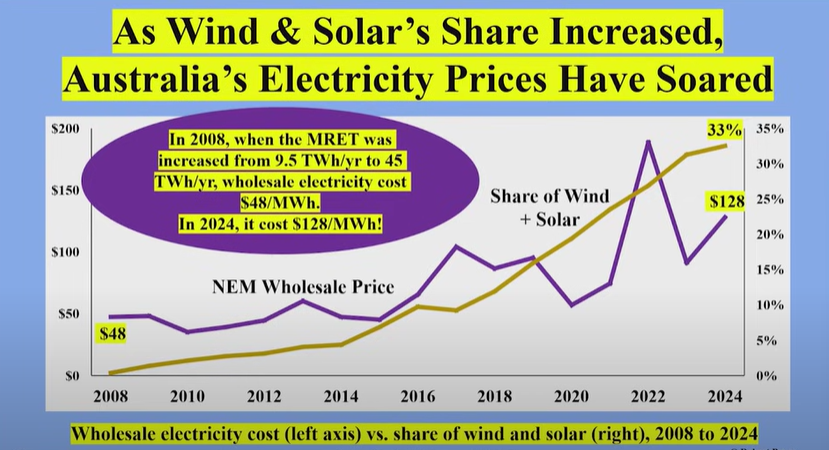
Bryce presented several slides that demonstrate the absurdity of Australia's policies. Here are a few of them.

  • Australia's contribution to world emissions is insignificant


  • China and India's increase in emissions is much greater than the reductions in emissions in the rest of the world.


  • Coal is NOT being phased out. The growth in coal-fired capacity is five times greater than the growth in nuclear capacity.


  • Australia's coal-fired generation is insignificant, so why close them prematurely?


  • World experience shows that cheap alternative energy is a myth.


  • Renewables (solar and wind) cause increases in electricity costs


  • Net Zero is very expensive


In summary
Given Australia's relatively insignificant contribution to global emissions, energy policy should be driven by cost and efficiency. Australia's Net Zero target should be abandoned as it is unattainable, and attempts to implement it will cause damage to Australia's economy without yielding any benefits in terms of global emissions reduction. The drive towards Net Zero would be self-inflicted harm.


Watch the Full Presentation


Tuesday, 7 March 2017

Malcolm must get back to basics

Some time before the last election I posted some gratuitous advice to Malcolm Turnbull (Malcolm must cut through). Advice on how he could cut through and score against his vulnerable yet emboldened opposition. Alas, it did not happen.

Looking back we can see that his tenure has been a steady decline in personal and party popularity, increasing back bench unrest and LNP supporters heading for the door. Many heretofore ardent advocates of the Turnbull 'brand' are wavering, while others have written him off. It is a dismal picture.

With a full two years to the next election I believe it is premature to write off the LNP, even with Malcolm Turnbull as its leader.

Without doubt however some things must change. In its current form it is drifting towards annihilation. Labor's return to office with its current policies would be a disaster for Australia, with increasing debt, lower living standards and further social disruption.

So what can Turnbull and his supporters do about it? How could they address this decline?

Back to basics

It should not be necessary, but given recent ambiguity/wavering on some policy issues, I believe all MPs would do well to familiarize themselves with the LNP's core principles as stated on their website.

"We Believe:
In the inalienable rights and freedoms of all peoples; and we work towards a lean government that minimises interference in our daily lives; and maximises individual and private sector initiative
In government that nurtures and encourages its citizens through incentive, rather than putting limits on people through the punishing disincentives of burdensome taxes and the stifling structures of Labor's corporate state and bureaucratic red tape.
In those most basic freedoms of parliamentary democracy - the freedom of thought, worship, speech and association. 
In a just and humane society in which the importance of the family and the role of law and justice is maintained. 
In equal opportunity for all Australians; and the encouragement and facilitation of wealth so that all may enjoy the highest possible standards of living, health, education and social justice. 
That, wherever possible, government should not compete with an efficient private sector; and that businesses and individuals - not government - are the true creators of wealth and employment. 
In preserving Australia's natural beauty and the environment for future generations. 
That our nation has a constructive role to play in maintaining world peace and democracy through alliance with other free nations. 
In short, we simply believe in individual freedom and free enterprise"
From Liberal Party website 
These are fine principles and should be ingrained in the soul of each LNP MP. They can be help to guide them out of many a political quagmire.

Of course the most effective messaging is when there is a contrast. So the principles should be stated and compared to those of the opposition.For example; -
  • The LNP stand for equality of opportunity for all. The ALP are forever raising taxes and re-distributing the hard earned income of even battlers to their government funded causes.
  • The LNP believe in equality of opportunity but accept that individual effort should be rewarded. The ALP is always "taxing the 'rich' and thereby removing the incentive that is required to generate wealth in the economy as a whole.
  • The LNP believes in free enterprise, that it is the private sector un-shackled from government interference that creates wealth. The ALP is always looking to government enterprises and government involvement. 

In the end there are two core messages that need to be ingrained in the electorate; - 

1. The LNP is the party of freedom for the individual to realise their potential 
2. The LNP are better economic managers because they believe in small government and look to private sector to generate wealth.

Most importantly there needs to be consistency; All policies must be aligned with these core messages, so the parliamentary party, LNP supporters and the electorate as a whole understand what the LNP stands for.

Unfortunately this has not been the case in recent times, with the LNP's tendency to squib harder issues. Look at 18 C for a blatant example.

If all policies were clearly and unambigously consistent with the LNP's principles, the flow of supporters away from the party would be stemmed and who knows, many may return to the fold.

Monday, 5 September 2016

Climate Change theatrics, again!

With the recent release of the report Towards a Climate Policy Toolkit by the Climate Change Authority (CCA), the finger-waggers are at it again. Two board members of the CCA joined by vested interests and an unquestioning media, are once again demanding Australia sign up to greater reduction targets than the those made at COP21 some 10 months ago.

But are such calls justified? Certainly not! Since industrialization Europe, the US and China have contributed the most to global warming. So they have to contribute the most to mitigate the impact of their emissions.  Australia, and the rest of the world, have had smaller contributions and therefore their fair share is lower.

Yet, self-serving advocates and the compliant media seem to gloss over these inconvenient facts.

Consider historical contributions


The greatest contribution to climate change since industrialization has come from the USA and Europe with significant contributions by China , Russia and Japan. (see graphic below.)

China is most notable for the speed with which it has become the largest annual emitter and a significant driver of global warming in its own right, despite its much more recent industrialization.

The historical contributions of just 5 countries, if you will permit me to call Europe a country, to global warming is approx 75%. Three quarters of all global warming (to 2011) is due to just these 5. One would therefore expect that the contribution to the mitigation effort should be commensurate. Quite simply if you caused 75% of the problem you should clean up 75% of the problem. You clean up your own mess. Well, let's see.

A vast majority of the pledges made at Paris were based on a nominated percentage reduction of GHG emissions below some baseline rate by a nominated deadline. The actual percentages and baseline dates vary but do not really impact on the problem. At first glance it may seem quite reasonable that each country makes commitments that reduce their own emission rates, especially if the reductions are of the same magnitude, and indeed most countries have chosen roughly similar reductions. So each country is effectively making equal commitments based on their own contribution. That's ok, isn't it?

No it isn't.

Climate change is the result of the cumulative impact of emissions over decades. So any mitigation should relate to the cumulative impact of a country.

But all Paris pledges are based on emissions rates as opposed to cumulative historical emissions.

And here is the problem. The large emitters, Europe and the US, and to a lesser extent Russia and Japan, went through industrialization a long time ago and have had high emissions for a much longer time. Their current annual emissions may still be high, but nowhere near their cumulative impact.

Lets look at the numbers. While the top 5 contributors to climate change represent 75% of cumulative emissions they only represent 50% of current emission rates. (see below)


So pledges based on current emission rates will always favor the earlier industrialized countries. 

But wait there is more

If that were not bad a enough there is a second problem.  GHG emission rates do not take into account the impact of imports and exports. The GHG generated in the production of goods is generally not included in the emission rates attributed to a country. So the producing country  has the burden of the emissions which are enjoyed by the consuming country. Countries like the US and Europe are major importers of high GHG products and therefore benefit from this error, while exporters like China bear the burden in their emission figures.

China is the elephant in the room

But let's not start feeling sorry for poor China. Yes, China can rightly expect an adjustment in their emission rates for the impact of exports, and it is not insignificant. It amounted to some 22% in 2005 and would, I guess be similar today (see my earlier post Seeking a fair GHG reduction target - Part 5: Who is responsible? which presents some of these figures with sources). However, even after adjusting for the exports error, China remains the largest annual emitter, by far.


In any case, China has virtually opted out of any reduction commitments. It has agreed to decrease the carbon intensity of its economy by 60-65% by 2030. But it had already committed to a 40% reduction by 2020, and it seems its extended commitment is really 'Business as usual', requiring it to simply continue along its current path of building more gas/nuclear power stations than coal fired ones.

China has justified its stance on the basis that its industrialization is relatively recent and that it should be accorded the same 'free emissions ' that the rest of the industrialized world enjoyed over the decades. That too may sound like a reasonable argument, but the figures don't stack up. China's Emissions per capita is already equal to that of Europe and also rising fast. So it should increase the standard of living of its citizens as is the case for Europe with no greater emissions than Europe's.


So like many arguments posed in this messy battle for the moral high-ground, it is self-serving, deceptive and false.

What is the fair share?

The fair share of global warming mitigation is for each country to clean up their own mess.

In other words their emissions reductions should be related to their historical contributions NOT their current emissions.

On this measure Europe, the US and China are not doing their fair share and have hoodwinked the rest of the world to contribute disproportionately to the global mitigation effort. Shame on them!