Welcome

Welcome to Grappy's Soap Box - a platform for insightful commentary on politics, media, free speech, climate change, and more, focusing on Australia, the USA, and global perspectives.
Showing posts with label Poverty. Show all posts

Wednesday, 31 August 2016

Towards heaven or hell?

Like many families we have our disagreements. These range across all manner of topics from the trivial, "what to watch tonight?", the mundane, "It's your turn to take out the garbage?", to the abstruse, "What is more important Art or Science?". Yet one of the topics that seems to spark the greatest passion relates to something that should be decided by just examining facts. It is the simple question "Is the world getting better"? Are we heading towards "heaven on earth" or "hell in a hand-basket"?

Dismissing for the moment the specifics, I find it fascinating that our small family group with, let's face it, similar backgrounds and attitudes to most things, can disagree so passionately on this question. Worse still this disagreement continues despite multiple attempts, yes heated attempts, to reconcile our opposing views. The observation that people of similar backgrounds can have viewpoints so opposing despite awareness of the same "facts" is a topic worthy of further exploration but I shall leave it for another day.

For the moment let's take a look at the question "Is our civilization heading towards the light or to darkness?"

Leaden Echo

There are many reasons to believe we are going to hell in a hand-basket.

Ever-present danger
Every day our news media focuses in on a human tragedy of some type or another, be it a terrorist attack, a natural disaster or disease that has cut short the lives of our brethren. Daily we are confronted with threats of war, or disease or climate catastrophe. We are constantly reminded that we live on a finite planet with scarcity of food, natural resources, and increasing pollution. Our airwaves emphasize our vulnerability, an omnipresent danger, and the potential for disaster.

As individuals we face the risk of  misadventure, physical violence, onset of disease, or financial stress to our selves or our loved ones.

As a community we are vulnerable to accidents and incidents, climatic events floods, drought or earthquakes, terrorism, outbreaks of disease, social upheaval, political instability and even war.

On a global we have the catastrophic climate change, nuclear conflagration or global pandemics.

So it is not surprising that we would feel our world is an unstable platform with a 'monster' around every corner.

The world is in a sorry state
If one takes a helicopter view of the world today we can only conclude that it is in a sorry state.

With some 7 billion souls to support our finite planet is straining under the load. The industries required to support this population are exhausting our natural resources and polluting our air land and sea. Our insatiable appetite for energy is generating greenhouse gases at a rate that is altering the climate.

Poverty and population pressures have fed into cultural conflicts creating widespread social unrest in the developing world. In the Middle East these have broken into multiple wars. These conflicts in turn have created vast numbers of refugees escaping violence and seeking better lives in the more prosperous regions of the world.  The sea of displaced are striving to re-locate into the wealthy developed world by fair means or foul.

Global terror networks seem to have infiltrated Europe and are bringing instability to a continent that had been at peace for half a century. China is playing games in the South China sea, Putin pushing boundaries around Russia at the very time the US has withdrawn from active leadership of the free world.

Nuclear weapons are spreading into less 'trustworthy' nations. Korea a failed state is already threatening its neighbours and developing delivery systems to threaten more distant foes. Iran never misses an opportunity to threaten Israel and it too is likely to have nuclear weapons in but a decade. So the potential for nuclear conflagration is increasing.

At the same time the arms industry is manufacturing weapons that give ever increasing destructive power to small groups or individuals. Who knows when a terrorist group or suicidal individual will obtain one of these to wreak havoc on a civilians. In recent Islamic terror attacks we have already seen the horrific impact of individuals and small groups hell bent on murder. Imagine if such attacks were executed with weapons of mass destruction.

By any objective assessment the world is in a sorry state. It seems the "towards hell" group should be easy winners.

The Golden Echo

Yet there is a compelling rejoinder. While the world may well be in a sorry state today, it was worse yesterday and the trend indicates it will be better tomorrow.

There are many facts supporting this thesis, but I will cover just a few.

In 2000 the UN established 8 Millennium Development Goals ; -

  • Eradicate Extreme poverty and Hunger
  • Achieve Universal Primary Education
  • Promote gender equality and empower women
  • Reduce Child Mortality
  • Improve Maternal Health Combat  HIV/Aids, Malaria and other Diseases
  • Ensure Environmental sustainability
  • Global Partnership and development.
The results as at 2015 are encouraging. Here are some of the highlights, you can check the rest here

From 1990 to 2015; -

Poverty
  • More than 1 billion people have been lifted out of extreme poverty since 1990. 
  • The proportion of undernourished people in the developing regions has fallen by almost half since 1990 
  • Between 1990 and 2015, 2.6 billion people gained access to improved drinking water sources. 
  • Between 2000 and 2014, more than 320 million people living in slums gained access to improved water sources, improved sanitation facilities, or durable or less crowded housing, thereby exceeding the MDG target. 
  • More than 880 million people are estimated to be living in slums today, compared to 792 million in 2000 and 689 million in 1990
Education
  • Among youth aged 15 to 24, the literacy rate has improved globally from 83 per cent to 91 per cent between 1990 and 2015, and the gap between women and men has narrowed.
  • Enrolment in primary education in developing regions reached 91 per cent in 2015, up from 83 per cent in 2000.
Gender Equality
  • The developing countries as a whole have achieved the target to eliminate gender disparity in primary, secondary and tertiary education. 
  • Women make up 41 per cent of paid workers outside of agriculture, an increase from 35 per cent in 1990 
  • The average proportion of women in parliament has nearly doubled over the past 20 years. 
Child Mortality
  • Between 1990 and 2015, the global under-five mortality rate has declined by more than half, dropping from 90 to 43 deaths per 1000 live births. 
  • Between 1990 and 2015, the number of deaths in children under five worldwide declined from 12.7 million in 1990 to almost 6 million in 2015. 
  • While Sub-Saharan Africa has the world’s highest child mortality rate, the absolute decline in child mortality has been the largest over the past two decades. 
Maternal Health

  • Since 1990, the maternal mortality ratio has been cut nearly in half, and most of the reduction occurred since 2000. 
  • More than 71 per cent of births were assisted by skilled health personnel globally in 2014, an increase from 59 per cent in 1990.
Combating HIV/Malaria and other diseases

  • New HIV infections fell by approximately 40 per cent between 2000 and 2013.
  • By June 2014, 13.6 million people living with HIV were receiving antiretroviral therapy (ART) globally, an increase from 800,000 in 2003.
  • Between 2000 and 2015, the substantial expansion of malaria interventions led to a 58 per cent decline in malaria mortality rates globally.
  • Since 2000, over 6.2 million deaths from malaria were averted, primarily in children under five years of age in Sub-Saharan Africa.
  • Tuberculosis prevention, diagnosis and treatment interventions have saved some 37 million lives between 2000 and 2013.
Environmental Sustainability
  • An increase in afforestation, a slight decrease in deforestation and the natural expansion of forests have reduced the net loss of forest from an average of 8.3 million hectares annually in the 1990s to an average of 5.2 million hectares annually between 2000 and 2010.
  • Ozone-depleting substances have been virtually eliminated, and the ozone layer is expected to recover by the middle of this century.
  • The world has met the target of halving the proportion of people without access to improved sources of water, five years ahead of schedule.
Global partnerships

  • In 2013, the debt burden of developing countries was 3.1 per cent, a major improvement over the 2000 figure of 12.0 per cent.
  • From 2007 to 2014, on average, generic medicines were available in 58 per cent of public health facilities in low-income and lower-middle-income countries.
  • 79 per cent of imports from developing countries enter developed countries duty-free.

But wait there is more...

The UN MDG demonstrate the world moving to address the targets set in 2000. While most targets areas require more attention, there has been very real progress.

We can also gain a glimpse of the state ofthe world and its direction from another informative site  Our World in Data.

This site is well worth a close look. It presents data across a range of factors including Population, Health, Energy, dissected by country and over time.

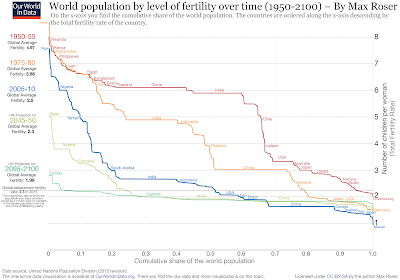
Here are some graphs showing how the world has changed (and is projected to change) over time for for Poverty, Human development Index, Democracy, Fertility, Life Expectancy, and Population.


Fig 1 Poverty is decreasing 


Fig 2 Human Development Index is increasing


Fig 3 The world is becoming more democratic.


Fig 4 Fertility rates are decreasing

Fig 5 Life Expectancy is increasing


Fig 6 World population is projected to peak


Of all the factors that one can use to gauge progress, Life Expectancy and Population are arguably the most important. Each of these measures is an amalgam of multiple factors. For example Life Expectancy is dependent on the availability and access to good quality food and healthcare. It indirectly 'measures' virtually all of the other factors that contribute to a successful society. its political systems, the wealth of its citizens, availability and access to food, shelter, healthcare, l as the efficiency of distribution of goods and services. Life expectancy can only increase if all of the factors contribute in a positive way hence it is ideal for measuring social health and over time progress. Life Expectancy for the world and each country in the world has shown pronounced growth over the last century. The world is getting better.

Similarly for World Population. Life expectancy in a world with uncontrolled population growth would be short lived. Life expectancy may increase for a while but then hit the wall. So it is essential for continued world progress that the world population stops growing. Figure 6 shows that despite increasing life expectancy fertility rates are dropping at a sufficient rate to ensure the population will peak somewhere between 10-13B around 2050 and then fall. This will ensure that the quality of life achieved for the wealthy nations today can be spread throughout the world in the next 100 years.

A better world beckons

The evidence paints a picture of the world in transition, a transition for the better. Yes, I have cherry-picked, omitting some issues of serious concern. Areas where the change over the past 25 years has seen deterioration. For example terrorism, and nuclear proliferation. Taken in isolation they are of concern and could lead to catastrophe. Historically, the world has faced many such potentially disastrous challenges. The little ice age, would have been seen as heralding global catastrophe in the 16-17th centuries Similarly during our world wars who could have argued that the world was improving? Yet just a few decades thereafter the world had recovered and to living standards better than beforehand. If you look at the graphs above you can see a steady improvement despite all the short term catastrophes. 

I picture our world history as a flowing river whose currents transport us towards that distant "better". Occasional shoals create turbulence and eddies that temporarily reverse our direction, but over time, inexorably, the great current of human development wins out and re-directs our flow towards progress. 

So despite the very real eddies we have faced and continue to face today, human evolution is towards a world much better than today.

Optimists live in a better world


You can guess which side of the argument I was on. But, of course, I have not convinced my family and don't expect to.

We live in our own worlds believing what we wish. My world is a happier place looking forward to better times for everyone.

Monday, 21 September 2015

Migration not a solution to world poverty

Recently I was sent a relatively old video, updated in 2010, "Immigration, World Poverty and Gumballs" by Roy Beck. It illustrates in a simple and compelling way, the futility of trying to address world poverty by immigration.

It provides a perspective of the size of the poverty problem and how even the most generous migration schemes cannot hope to address the issue.Moreover and this point needs to be emphasized the very generosity of the west in accepting migrants actually makes the problem worse, because the migrants accepted are always the very migrants who could work assiduously to make their home countries better.

While the figures are no doubt out of date, the message is equally relevant today. Indeed, with waves of migrants spreading over Europe they are more relevant than ever.

Should Europe accept these migrants?  Without qualification it is incumbent on all countries to re-settle refugees from war and persecution (see my earlier post on the migration crisis). There is however no obligation to accept so called 'economic' migrants, those who leave their home countries in search of greener pastures.

So often the heart works against the mind. We feel a collective guilt for our prosperity and do not want to deny a chance to at least the few on our doorsteps. Yet we know that we can only offer this to a few, that it encourages ever greater numbers of dissatisfied souls to leave their lands and indeed that it robs their home countries of the most energetic and capable.

The 'gumball' message is clear, it is counter-productive for western developed countries to accept the migrants best equipped to transform their own countries into the type of societies they seek. 

Tuesday, 15 September 2015

Migration crisis

The scenes of the beleaguered migrants, asylum seekers, or refugees, in camps, in un-seaworthy vessels, and in the sea, drowned bodies, anguished and pained faces, children, mothers, grandmothers assail us. Who cannot be moved to demand action.
It is without doubt a reminder that this world can be a terrible place, if by chance you were born in the wrong time or the wrong place.There is nothing fair about this. Why can some humans live a civil life, without want for food or security, while others are deprived of these human rights. It is not a just world.

Taking stock in a troubled world

Our world is in a sorry state.Wars ravage too many countries, Somalia,Yemen, Syria, Libya, Iraq, Sudan,Ukraine, and others. The great strides in communication technologies have opened up a window to life in all parts of the globe. For the destitute peoples of Africa and Asia, the relative affluence of the developed world is a magnet. Large numbers of people either escaping persecution, and war, or just trying to improve their lives, are all too willing to leave their countries and seek 'asylum' elsewhere. The numbers are staggering, estimates give some 20 million currently living in refugee camps as at end of 2014, but most probably double that in various states of transit across the globe.

Most refugees simply escape war or persecution and join others in camps in the country adjacent to the conflict. They then seek to migrate to the more generous developed world. In response to the escalating need some developed countries have increased their refugee intake from but a few thousand to a few thousand more. Even Germany's dramatic increase to an unprecedented 800,000 this year is but a drop in the ocean when facing a total over 40m.

There is of course widespread media coverage with dramatic scenes of human misery. So we have full time coverage. Emotions in the electorate are running high, and politicians cannot avoid taking some action. But what can they and what should they do? Our government's widely welcomed commitment to resettle an additional 12,000 refugees from the camps is a token. In comparison to other developed countries it is perhaps generous, but it remains nothing but a token when looking at the size of the problem.

Lets face some facts

The current wave of migration is unusual in its extent and size. It has been compared to the wave of relocation following WWII. Yet all efforts to date have been insignificant. Until this wave of refugees broke the shores of Europe over the past 12 months, the West has ignored the problem.

Now, no longer. With tens of thousands of 'migrants' flowing into Italy, Greece, Hungary they are a very visible, ever-present and growing problem.

For Europe solutions are particularly challenging. The European Union was built on a respect for every individual and has long espoused universal human rights. However the large numbers present a problem for even the largest economies. There is of course the very real costs required to house, feed and integrate the new migrants. For the smaller economies who are struggling with their own welfare systems this is no minor issue. But the greater challenge for the largely Christian Europe is cultural, how to accept large numbers of Muslim migrants into your society without changing it.

In all these respects, this mass migration presents a complex dilemma to the developed world.

I do not claim a 'solution', but I think most of our commentators and much of the media seem to avoid some unwelcome facts. Perhaps this is due to political correctness. Perhaps it is hard to look dispassionately at human suffering. Perhaps it is a fear that any harsh judgment will result in criticism directed at the 'messenger'. Indeed this may well result from my voicing some of these issues. Nevertheless, I believe real solutions can only arise if we are honest about the size and nature of the problem. So let me venture some observations.

Borders should be closed 
  • Not all 'asylum seekers' are refugees and they should not be treated in the same way.
  • The world has too many people who if given the chance have the means to travel to countries which have open borders and which will offer a better life.  
  • Germany opening its doors to some 800,000 has caused a virtual run at the borders. This is unsustainable and damaging to every country in the Eurozone. 
  • Large and sudden increases in the number of migrants causes economic and social burdens on the receiving countries. Failure to manage the rate of increase and the integration can lead to social unrest, which manifests itself in increased poverty and crime rates and lowers living standards for everyone. 
  • Responsible governments will limit their intake of migrants to ensure their own social structures remain intact. Even countries adjacent to conflict zones have enforced camps to limit the impact on their own populations. This is not racism and it is not unreasonable.
Refugees in camps should be given priority for resettlement
  • There are millions of poor souls who don't have the means to pay people smugglers or who would not risk the lives of their families. 
  • Those who are leaving the camps are trying to 'jump the queue'.
  • Those who claim to be refugees and have already left a country where they were safe should be returned to a refugee camp, closest to their point of departure, before being processed. (I have specifically not mentioned the UN convention for refugees, which requires refugees to seek asylum from the first signatory country. It is a sufficient condition that a genuine refugee apply for resettlement from the first country where it has refuge. It goes without saying that those in camps in Turkey and Jordan are safe from the Syrian war.)
  • Priority for resettlement should be given to those who have stayed in a camp the longest.
Refugees should not be allowed to chose the country into which they are to be resettled
  • Refugees are escaping persecution or war. They are by definition looking for refuge and should automatically be satisfied by whichever country offers this.
  • A UN body, most probably the UNHCR should manage the resettlement process. 
    • All countries offering places for refugee resettlement should register these with the UNHCR
    • Each refugee family should be offered a resettlement country randomly selected.
    • A family should have the option to reject the country of resettlement but if they did so they would go to the bottom of the queue for the next selection, and may indeed stay in their camp for years.
  • Countries accepting refugees for resettlement also retain their rights to select which refugees they will accept
  • A vital consequence of this process is that economic refugees would NOT register as refugees
Funding for refugees has to be provided by the world
  • All countries as part of their obligations to the UN should offer to fund the resettlement of refugees. 
  • Quite separately all countries should also offer to resettle refugees.
  • UNHCR should allocate a fixed US$ amount per person being resettled into a country. This should equate to at least the first 12 months cost of housing and feeding the refugee. This amount should be paid to the resettling country as an incentive for even poorer countries to accept refugees.
  • There should in addition be a levy on all countries to ensure the refugee camps are maintained to preserve the well being and dignity of those who are forced to stay in camps till they are resettled.
Stop the wars
  • Refugees are a symptom of failed states, and indeed a failed world system
  • The world needs to be far more proactive in ensuring leaders do not threaten their own people.
  • In many of the troubled areas of the world small groups of armed thugs hold their populations hostage to their whims. In most of these cases the UN and the West could very simply remove the tyrants from power and they should do so.
  • I accept that with wars, especially where larger nations are involved, it is far more difficult and we are yet to develop a UN-like body that is effective in these situations.

Clear the camps

One of our millennium goals should be to clear the camps. Too many camps around the world have become the way of life for too many and for too long. 

Monday, 3 November 2014

Is our poverty line straight?

I was surprised to learn that according to the recently published report by Australian Council of Social Service (ACOSS) some 14 percent of Australians are below the 'internationally accepted poverty line"( http://www.acoss.org.au/policy/poverty/).

One in 7 Australians living in poverty is a terrible indictment for a rich country like Australia.

However, in view of Australia's increasing standard of living over the past 15 years (see http://www.natsem.canberra.edu.au/storage/Cost-of-Living-September-2013.pdf ) and Australia's ranking as number 2, behind only Norway, in the Human Development Index (see http://hdr.undp.org/en/content/table-1-human-development-index-and-its-components), it made me curious. What are these figures? Where do they originate? What is this poverty line?

So I did a little research. I downloaded the rather lengthy report from ACOSS. You can download it here.

I also followed up on Wikipedia to see what other countries were doing and how Australia compared with other countries.

As you delve, there is a lot to learn, and I confess I have more questions than answers. Nevertheless I have gleaned a few snippets.


What does ACOSS mean by 'poverty line'? 

The report defines the 'internationally accepted' poverty line for a single adult as 50% (or 60%) of the 'middle income' (median) single income household. There are different 'poverty lines' for different types of household. ACOSS however uses an adjusted figure by excluding housing costs, arguing that 'in this way , it compares different households' ability to meet their basic living costs apart from housing." Let's take that at face value , for now.

Wikipedia provides a less dogmatic definition noting that while many developed countries use the above definition, others also use the average rather than the median, and more importantly poorer countries tend to use an absolute definition of poverty based on daily earnings of but a few dollars per day. 

More questions than answers

The method used by ACOSS to calculate their published figures from the definition is still a bit of a mystery to me and has left me with a number of questions (see below). However there is an overriding problem with the definition. 

Simply, the 'poverty line' as defined, does not measure poverty in the normal sense of the word, ie a level of deprivation. It provides a sort of measure of distribution of income across a society, but not what we commonly mean by poverty.

Ok, I need to illustrate. 

Recall that ACOSS defines the poverty line as an income level  of 50%(or 60%) of the median household income for any family group. 

So imagine, one day miraculously, every employer decides to double everyone's income but without a commensurate change in the cost of goods. Yes I know this is unlikely, but hear me out it is only to illustrate this point. 

If everyone is earning double what they used to earn, with costs not having changed, you would expect that there should be less people living under the poverty line. But according to the ACOSS definition, not one person who was below the poverty line before this sudden increase in wealth is raised above the poverty line.  This is because the poverty line definition is based only on income distribution, totally ignoring the cost of living. Whereas we know poverty is not based on just income but what that income will purchase.

So clearly the definition is flawed, and really badly flawed. 

Now I am not saying that people living below the ACOSS poverty line are not deprived. I fully accept that there are significant numbers of fellow Australians who live in poverty. My point is that the ACOSS poverty line is NOT an appropriate measure for who is and is not in poverty, and therefore it should be replaced by a measure that takes into account both income and living costs for each family group.

Further questions

Even if we did accept the ACOSS definition, other problems arise. ACOSS does not break down the income distributions by geographic region. This is despite large variations in both the income and the cost of living across states, cities and rural regions. 

For example in 2011, 13.7% of households in Regional Tasmania earned between $400-$599 per week compared to 9.3% aggregate for Australia as a whole and 4.7% of households in the ACT. (see  http://profile.id.com.au/australia/household-income?WebID=170 )

This shows very wide variation in incomes by geographic region.  The same is also true for the cost of living. For example You would need around $5,500 in Hobart to maintain the same standard of life that you can have with $7,100.00 in Sydney, assuming you rent in both cities (see http://www.numbeo.com/cost-of-living/compare_cities.jsp?country1=Australia&country2=Australia&city1=Sydney&city2=Hobart)

Once again the ACOSS poverty line can grossly mis-assign poverty. A person in Hobart with an above poverty income may find it a real struggle to live in Sydney. 

Clearly any measure of real deprivation should take into consideration the cost of living and the income in the geographic region in which the household is located.  Without this all that can be concluded is that the ACOSS poverty line gives some , rather ill-defined, measure of income distribution.


Why does this matter?


We are a rich country and want to be generous to our citizens, so this poverty line is a measure of our success as a society , at least in some senses.

Whilever there is competition for our tax dollars poverty rates will be amplified as a weapon against tight fisted governments in order to increase welfare spending.

ACOSS serves its purpose well in publishing headline poverty rates that are perceived as high, and increasing year on year. 

I share the common ethos of most Australians to provide generously for the disadvantaged. Therefore I take no issue with ACOSS' role seeking to limit poverty. However using false and misleading measures will tend to be discounted and can turn counter-productive. I believe the method of measuring poverty should be revised. ACOSS' poverty line, based only on income, should be replaced by a measure which really reflects both income and cost structures across geographic zones.

In the end, the best remedy for poverty may not be though increasing welfare payments, but through the availability of jobs and training.  More spending on welfare can be counter productive, as it removes responsibility from the individual and also the satisfaction that comes from doing an honest days work, but that is a discussion for another day